International Psoriasis Council

Advancing Knowledge. Improving Care.

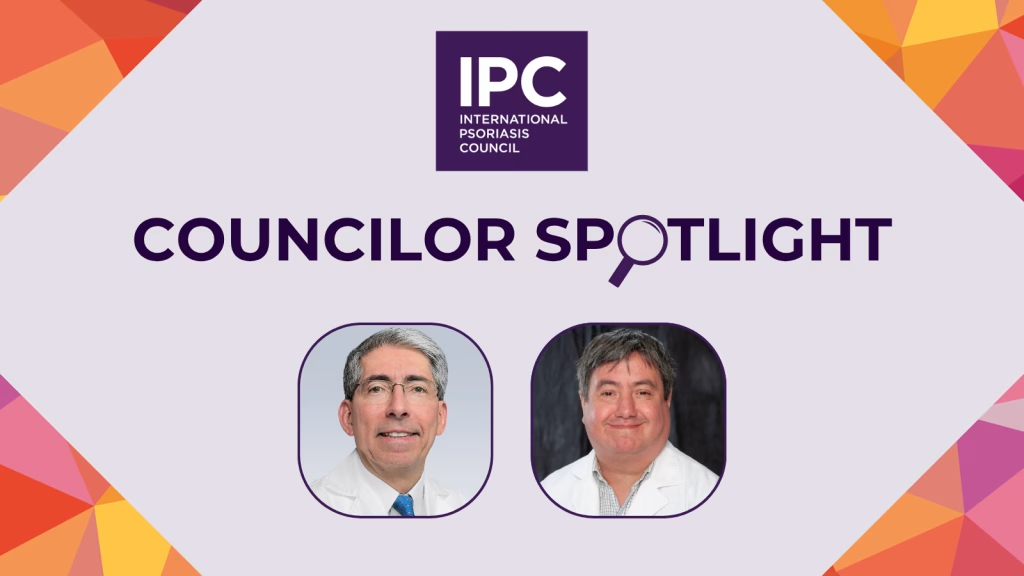
IPC Welcomes New Councilors Dr. Steven Fakharzadeh and Dr. Rodrigo Garcia Salinas

From Skin to Joint: IPC Welcomes Two New Councilors

The International Psoriasis Council (IPC) welcomes two new Councilors whose work will strengthen IPC’s reach across the full arc of disease, from skin to joint. Steven Fakharzadeh, MD, PhD, brings deep experience in pharmaceutical and clinical development, with a focus on early intervention and long-term remission strategies for psoriasis. Rodrigo Garcia Salinas, MD, brings rheumatology expertise in the early identification and management of psoriatic arthritis.

Steven Fakharzadeh, MD, PhD

University of Pennsylvania

Philadelphia, Pennsylvania, United States

IPC Councilor

Bio
Dr. Fakharzadeh is an Adjunct Professor of Dermatology at the University of Pennsylvania, where he teaches and sees patients with hereditary skin conditions. His clinical focus spans psoriasis therapeutics, early intervention, and long-term remission. Over a 17.5-year career at Johnson & Johnson, he led Global Medical Affairs for Dermatology, contributing to development programs for ustekinumab, guselkumab, and icotrokinra. He serves on the Medical Board of the National Psoriasis Foundation (NPF).

Rodrigo Garcia Salinas, MD

Hospital Italiano de La Plata

La Plata, Argentina

IPC Councilor

Bio
Dr. Garcia Salinas is a rheumatologist and Head of the Arthritis and Spondyloarthritis Unit at Hospital Italiano de La Plata. His research focuses on psoriatic arthritis and axial spondyloarthritis, with particular interest in early diagnosis, imaging, and treatment outcomes. He serves as Coordinator of the Pan American League of Associations for Rheumatology (PANLAR) PsA and axSpA Study Group. He is a principal investigator of ESPALDA, a Latin American multicenter registry for axial spondyloarthritis.

A Wider View for IPC

Together, Dr. Fakharzadeh and Dr. Garcia Salinas broaden IPC’s global perspective, bridging drug development and dermatology in the United States with rheumatology care in Latin America, and strengthening IPC’s work across the full spectrum of psoriasis. Their combined expertise reflects IPC’s commitment to connecting specialties and regions to pursue better outcomes for people living with psoriasis and related conditions worldwide.

Categories

Recent Posts

When Cancer and Psoriasis Coexist: New IPC Guidance Puts Clarity Where It Is Needed Most

Reframing Obesity in Psoriatic Disease: From Pharmacokinetic Barrier to Therapeutic Target

Psoriasis and Metabolic Health: What IPC’s Latest Publication Means for Clinical Practice

Also Read

Subscribe to the IPC Newsletter

Stay up-to-date on the latest research, news, and upcoming events right in your inbox.

What's New

When Your Patient with Psoriasis Is Diagnosed with Cancer

A patient doing well on an IL-17 inhibitor is diagnosed with cancer, and the oncologist wants the biologic stopped. It is a call most dermatologists have made without much to stand on: patients with cancer are excluded from psoriasis trials, so the entire evidence base is observational. A new IPC paper in JAAD Reviews takes a position anyway. Per the summary of product characteristics, active malignancy is not a contraindication to any biologic. IL-17 and IL-23p19 inhibitors are first-line, TNF inhibitors and deucravacitinib warrant caution, and cyclosporine is the one to avoid outright. The authors also warn that psoriasis severity is routinely underestimated once a patient is in oncology care: if they meet IPC’s criteria, they are a candidate for systemic therapy regardless of what else is on their problem list. “Too often, systemic psoriasis therapy is discontinued or never initiated in patients with cancer, even when the evidence supports safe and effective options,” says Paolo Gisondi, MD, IPC Councilor and lead author. The post includes the therapeutic options figure, designed as a reference for both specialties to work from, and a slide set for teaching and presentations.

READ NOW

Thursday, August 27, 2026

Apply Now: 2027 IPC International Fellowship Program

IPC is accepting applications for the 2027 International Fellowship Program, a 12-month opportunity for early-career dermatologists and researchers focused on psoriasis. Fellows are matched with IPC Board Members or Councilors for hands-on clinical or research experience, along with virtual mentoring, skills-development classes, and ongoing connections to IPC’s global network throughout the fellowship year. Applications are open until September 30, 2026.

APPLY NOW

Monday, August 31, 2026

IPC Generalized Pustular Psoriasis (GPP) Training Modules

Recognizing GPP in clinical practice can be a challenge, even for experienced dermatologists. IPC’s new five-part training series walks clinicians through the practical skills needed to diagnose and assess GPP with confidence: distinguishing it from plaque psoriasis and other mimicking conditions, and scoring its severity using tools such as the GPPGA and GPPASI. Each module pairs an expert-led video with a case-based exercise, and the series is built to be completed in sequence at your own pace. All five modules are free and open to everyone; watch the videos on your own or work through the assessments as you go. Score 80% or higher on each of the five assessments to earn a Certificate of Completion.

LEARN MORE

Thursday, August 13, 2026

IPC Summary Slides: Psoriasis and Metabolic Health

IPC has released a set of summary slides distilling the key findings from its recent publication on psoriasis and metabolic health, published in the Journal of the American Academy of Dermatology (JAAD). The paper outlines five priorities for improving cardiometabolic risk screening and care in patients with psoriasis. Designed for sharing, the slides give clinicians and colleagues an easy way to disseminate the findings.

LEARN MORE

Wednesday, August 5, 2026

Paradoxical Psoriasis - María Julia Cura, MD

In this Take Ten with IPC video, IPC Junior Councilor Dr. María Julia Cura discusses paradoxical psoriasis, including its definition and pathogenesis, and reviews clinical case examples, key clinical features, histopathology, predictors of disease severity, and potential treatment options.

WATCH NOW

Monday, August 3, 2026