- Bryan Guevara, MD, FPDS, FPDSP-PDS, ICDP-UEMS, Dina ElDisouki, MD, Ralph Vighi da Rosa, MSc, MD, and Josep Riera-Monroig, MD
- Congress Reports, Comorbidities, Diagnosis, Quality of Life, Research, Treatment
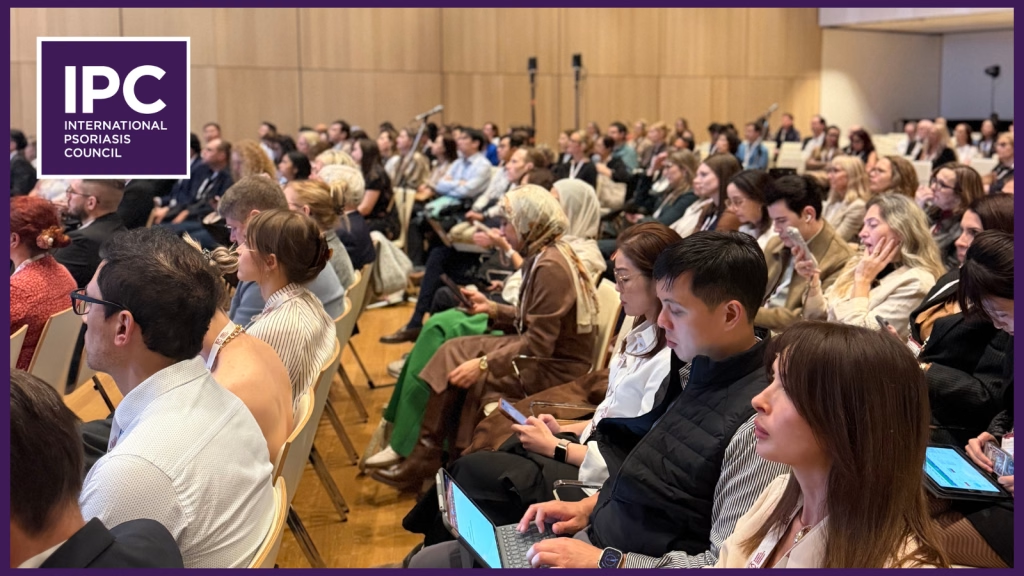
The 35th European Academy of Dermatology and Venereology (EADV) Congress took place at the Austria Center Vienna in Vienna, Austria, from Wednesday, Sept. 30, to Saturday, Oct. 3, 2026. This blog post provides an overview of key psoriasis sessions, including the IPC Symposium: At Last! Personalized Medicine for Psoriasis, and selected late-breaking research. Download the full 2026 EADV Congress Report for a comprehensive review or continue reading for session highlights.
IPC SYMPOSIUM: AT LAST! PERSONALIZED MEDICINE FOR PSORIASIS
Catherine Smith, MD, IPC Board Member, and Alexander Navarini, MD, PhD, IPC Councilor, chaired the symposium, with Peter van de Kerkhof, MD, PhD, IPC Chief Medical Officer, and Dina ElDisouki, MD, IPC Jr. Councilor, joining as panelists. The session traced personalized psoriasis care across three connected dimensions: molecular profiling to characterize disease, precision dosing to tailor treatment exposure, and digital technologies to extend assessment and access.
Approaches to Personalized Medicine: From the Clinical to the Molecular
Curdin Conrad, MD, IPC Board Member
Professor Curdin Conrad examined how integrating clinical assessment with molecular profiling could advance personalized psoriasis care. He described molecular profiling of skin biopsies to characterize innate and adaptive immune signatures. He explained how targeted gene-expression platforms may identify discordance among the presumed diagnosis, the dominant inflammatory pathway, and the selected therapy. The presentation emphasized overlapping immunologic patterns in psoriasis, including chronic inflammation involving interleukin (IL)-23 and IL-17, acute inflammation associated with type I interferon, and pustular inflammation involving the IL-36 and IL-1 axis, while noting that clinical validation remains essential before molecular guidance enters routine care.
Therapeutic Drug Monitoring and Dose Optimization: Clinical and Practical Considerations
Satveer Mahil, PhD, FRCP, IPC Councilor
Dr. Satveer Mahil examined therapeutic drug monitoring and dose optimization as alternatives to fixed biologic dosing, which overlooks variability in drug exposure and response. She reviewed serum concentration thresholds that inform treatment adjustments and described model-informed precision dosing, which uses Bayesian forecasting to combine population pharmacokinetic models with individual patient characteristics. Interim data from the PLAN-psoriasis feasibility trial indicated high clinician usability and patient acceptability, with 49% of patients receiving lower-than-standard dosing at a mean interval of 16 weeks.
Digital Technologies: What’s Out There for Psoriasis?
Alexander Navarini, MD, PhD, IPC Councilor; Tamar Nijsten, PhD
Professor Alexander Navarini and Professor Tamar Nijsten reviewed digital approaches in psoriasis, including molecular sampling, optical imaging, artificial intelligence (AI), and remote monitoring. They discussed skin wash and tape stripping for cytokine detection, line-field confocal optical coherence tomography, and AI-assisted severity scoring, noting that external validation across centers, skin tones, and diverse populations remains essential. Implementation barriers in low-income countries include limited access to specialists, unreliable internet connectivity, scarce equipment, high costs, and limited digital literacy. The presenters emphasized that digital tools should be measured by patient outcomes and equitable access rather than technical performance alone.
We encourage you to download the full 2026 EADV Congress Report for comprehensive coverage of psoriasis-focused sessions, detailed summaries, and complete findings.
OTHER PSORIASIS SESSIONS
Group for Research and Assessment of Psoriasis and Psoriatic Arthritis (GRAPPA): Advancing Personalized Care in Psoriatic Disease: From Early Detection to Precision Therapeutics
April Armstrong, MD, MPH, IPC Councilor; Ahmet Uğur Atilan, MD; Kilian Eyerich, MD, PhD, IPC Councilor; Alice Gottlieb, MD, PhD, IPC Councilor; Leandro Leite, MD, MSc, IPC Councilor; Lone Skov, MD, PhD, IPC Board Member
Presenters examined early detection, measurement, and treatment selection in psoriatic disease. Dr. Leandro Leite reviewed evidence linking skin inflammation to joint inflammation and the potential of early biologic treatment to reduce the risk of psoriatic arthritis (PsA), and Dr. April Armstrong discussed shared decision-making and testing designed to predict therapeutic response. Dr. Alice Gottlieb reviewed instruments that measure musculoskeletal symptoms independently of skin disease; Professor Lone Skov presented the GRAPPA expert consensus on difficult-to-treat PsA; Professor Kilian Eyerich described molecular stratification of psoriasiform phenotypes; and Ahmet Uğur Atilan reviewed therapeutic combinations and reasons for nonresponse.
Understanding Psoriasis (Updates)
Hervé Bachelez, MD, PhD, Past IPC President; José-Manuel Carrascosa, MD, PhD, IPC Councilor; Johann Gudjonsson, MD, PhD, IPC Board Member; Satveer Mahil, PhD, FRCP, IPC Councilor
Four lectures examined psoriasis in relation to obesity, pustular disease, special sites, and monogenic mechanisms. Dr. José-Manuel Carrascosa presented obesity as a modifiable comorbidity affecting about 30% of patients and reviewed incretin-based therapies as emerging adjuncts. Dr. Johann Gudjonsson described pustular psoriasis as driven by interleukin-36 signaling, with spesolimab data in generalized pustular psoriasis. Dr. Satveer Mahil highlighted the disproportionate burden of scalp, face, genital, flexural, palmoplantar, and nail disease, and Professor Hervé Bachelez showed how monogenic disorders, including CARD14, IFIH1, DDX58, and ADAR1 variants, reveal distinct disease mechanisms.
Treating Psoriasis (Updates)
Curdin Conrad, MD, IPC Board Member; Kilian Eyerich, MD, PhD, IPC Councilor; Jo Lambert, MD, PhD, IPC Councilor; Julia-Tatjana Maul, MD, IPC Councilor
This session reviewed topical, biologic, and oral therapy alongside the emerging concept of disease modification. Professor Jo Lambert noted that topical therapy is still used in 80% of patients and that advances in vehicles, precision signaling, and delivery have changed how topicals are selected. At the same time, Dr. Julia-Tatjana Maul outlined current treatment goals and compared tumor necrosis factor-α, interleukin (IL)-23, and IL-17 inhibitors. Professor Curdin Conrad reviewed oral therapies in development, including targeted oral peptides and tyrosine kinase 2 inhibitors, and Professor Kilian Eyerich addressed disease modification, including the window of opportunity and maintenance of response after treatment withdrawal.
Free Communication 5: Psoriasis
April Armstrong, MD, MPH, IPC Councilor; Khaled Ezzedine, MD, PhD; Anastasia Fleyder, MSc; Melinda Gooderham, MSc, MD, FRCPC; Sana Gupta, MD Candidate; Luciano Ibba, MD; Yuling Shi, MD, PhD, IPC Councilor; Yulin Zou, PhD Student
Presenters reported new data across treatment, pathogenesis, and diagnosis. Dr. Yuling Shi presented a bispecific interleukin (IL)-23p19/IL-36R antibody that produced Psoriasis Area and Severity Index (PASI) 90 responses in 90% of patients at week 16 after a single 600 mg dose, and also reported a subgroup analysis showing no significant efficacy differences by body mass index or body weight for picankibart at the same dose. Dr. April Armstrong discussed durable efficacy with zasocitinib after discontinuation; Luciano Ibba presented early PASI response as a predictor of long-term clearance with risankizumab; and Sana Gupta reported an indirect comparison of icotrokinra with injectable IL-23 inhibitors.
Psoriasis (Training and Education)
Álvaro González-Cantero, MD, PhD, IPC Councilor; Vali Mateeva, MD, PhD; Catherine Smith, MD, IPC Board Member; Diamant Thaçi, MD, PhD, IPC Councilor
This session covered the essentials of psoriasis care, from clinical subtypes and severity assessment to comorbidities and treatment. Dr. Vali Mateeva reviewed the heterogeneity of nonpustular and pustular forms, and Dr. Diamant Thaçi described severity as multidimensional, encompassing biological measures, quality of life, treatment response, and comorbidities. Dr. Álvaro González-Cantero reviewed cardiovascular and metabolic comorbidity data, and Professor Catherine Smith discussed systematic assessment, shared decision-making, and the questions to ask when treatment fails.
LATE BREAKING NEWS
Long-Term Durability and Safety of the Targeted Oral Peptide Icotrokinra for High-Impact Site Psoriasis: 2-Year Findings from the ICONIC-TOTAL Randomized Controlled Trial
Richard B. Warren, MBChB, PhD, IPC Councilor
Professor Richard B. Warren presented two-year (week 112) data from ICONIC-TOTAL, an ongoing phase 3 trial of the targeted oral peptide icotrokinra in adults and adolescents with plaque psoriasis and at least moderate involvement of one or more high-impact sites. Responses achieved by week 24 were maintained through week 112, including an Investigator Global Assessment score of 0/1 in 70% of patients overall, with sustained responses at scalp, genital, hand and foot, and nail sites. Exposure-adjusted adverse event rates did not increase with longer treatment across 564 patient-years, and no new safety signals were identified.
Zasocitinib Versus Deucravacitinib in Moderate to Severe Plaque Psoriasis: Results from the Phase 3 Head-to-Head LATITUDE Atlas Trial
Linda Stein Gold, MD, IPC Councilor
Dr. Linda Stein Gold presented LATITUDE Atlas, the first head-to-head dermatology trial comparing two agents with the same mechanism of action and the first psoriasis trial of oral agents to use a 100% improvement in the Psoriasis Area and Severity Index (PASI 100) as the primary endpoint. At week 16, zasocitinib was superior to deucravacitinib on every key endpoint, including PASI 100 (36.5% versus 13.9%) and PASI 90 (62.5% versus 34.0%), with the arms separating from week 8. Treatment-emergent adverse events were mostly mild or moderate, and rates of serious adverse events and discontinuations were similar between arms.
We encourage you to download the full 2026 EADV Congress Report for comprehensive coverage of psoriasis-focused sessions, detailed summaries, and complete findings.