- IPC GENERAL
- Drug Approvals, IPC News, IPC Publications, Publications, Treatment Guidelines
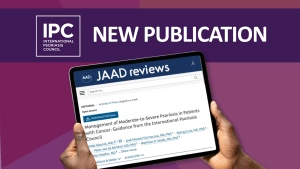
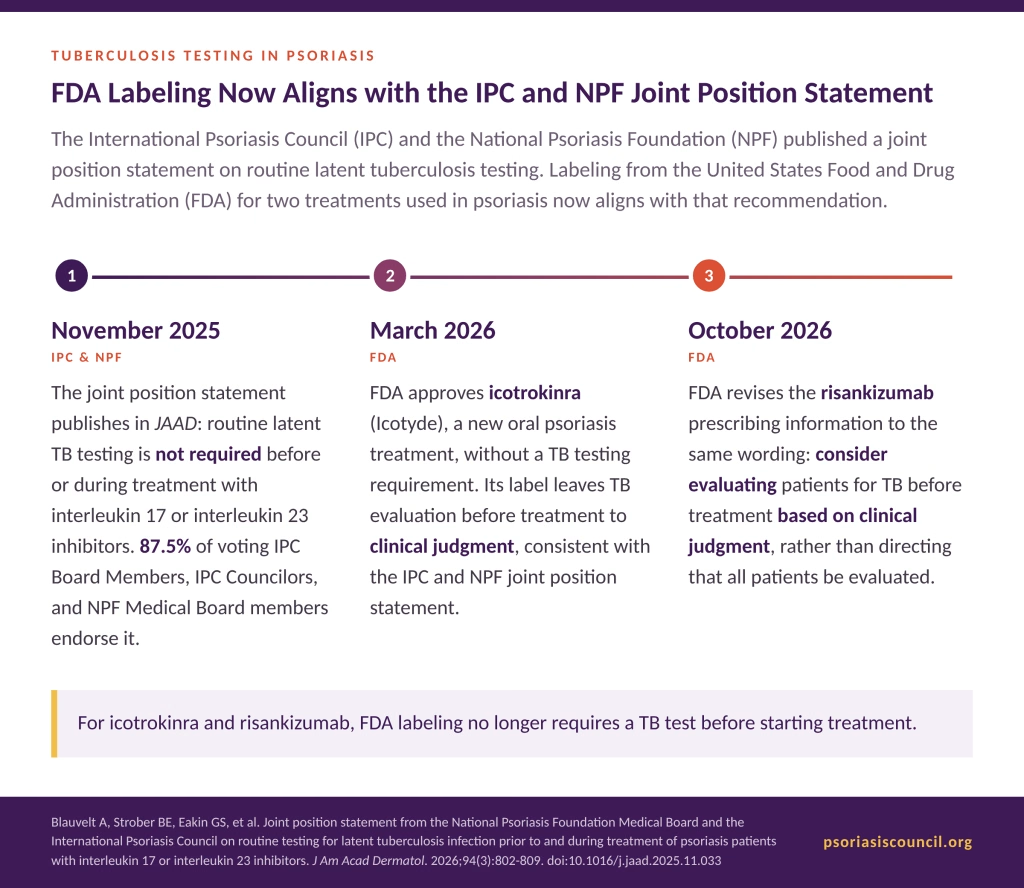
In November 2025, the International Psoriasis Council (IPC) and the National Psoriasis Foundation (NPF) published a joint position statement in the Journal of the American Academy of Dermatology (JAAD) recommending against routine latent tuberculosis (TB) testing for psoriasis patients treated with interleukin 17 (IL-17) or interleukin 23 (IL-23) inhibitors. Labeling from the United States Food and Drug Administration (FDA) for two treatments used in psoriasis has since come into line with that recommendation.
What the Statement Recommends
The 16 authors found no reports of extra-pulmonary or disseminated TB for the IL-17 and IL-23 inhibitors studied, compared with 26 for tumor necrosis factor-α inhibitors. Their review drew on clinical trial data, real-world cohorts, and United States pharmacovigilance records.
The statement concludes that routine testing for latent TB infection is not required before or during treatment with IL-17 or IL-23 inhibitors. Continued testing could be considered for patients in TB-endemic regions and for patients receiving concomitant immunosuppressive therapy. The recommendation covers only IL-17 and IL-23 inhibitors, and screening practices for tumor necrosis factor-α inhibitors remain unchanged.
IPC Board Members, IPC Councilors, and the NPF Medical Board voted on the final recommendation. Of the votes received, 87.5% supported endorsement. Most of those who dissented practice in TB-endemic areas.
When the statement was published, Andrew Blauvelt, MD, MBA, an IPC Board Member and Chair of the NPF Medical Board, put the request to regulators directly, stating, “We encourage drug manufacturers and regulators to confidently embrace this recommendation.”
What Changed in FDA Labeling
In March 2026, FDA approved icotrokinra (Icotyde), a new oral IL-23 receptor antagonist for plaque psoriasis, without a requirement for routine TB testing. Its prescribing information advises clinicians to “consider evaluating patients for tuberculosis (TB) infection prior to initiating treatment… based on clinical judgement,” and to monitor for active TB during and after treatment. On April 7, 2026, NPF reported that the joint position statement had been shared with FDA during the drug’s review.
In October 2026, FDA revised the prescribing information for risankizumab, which now carries the same wording. It advises clinicians to “consider evaluating patients for tuberculosis (TB) infection prior to initiating treatment with SKYRIZI based on clinical judgement,” rather than directing that all patients be evaluated beforehand. Risankizumab is approved for psoriasis, psoriatic arthritis, Crohn’s disease, and ulcerative colitis, so the revision reaches patients well beyond dermatology.
Neither label removes TB caution altogether. Both direct clinicians to avoid giving the drug to patients with active TB, and to consider anti-TB therapy before treatment in patients with a history of latent or active TB in whom an adequate course of treatment cannot be confirmed.
What This Means for Patients
TB testing has delayed treatment, added cost, and produced false positives that require follow-up before therapy can begin. Removing routine testing shortens the path from prescription to first dose.
Bruce Strober, MD, PhD, President of IPC, says, “Our joint statement with NPF showed that, for patients starting IL-17 or IL-23 inhibitors, routine TB testing adds delay and cost without a clear safety benefit. It’s encouraging that FDA now leaves TB screening to clinical judgment for both icotrokinra and risankizumab, rather than requiring it. We’ll continue to share this evidence with regulators and clinicians worldwide, while recognizing that testing remains appropriate in TB-endemic settings and for patients on other immunosuppressants.”
FDA regulates in one country. Routine TB testing weighs most where testing capacity is thinnest and false positives are most common. The joint position statement reflects the votes of IPC Board Members and Councilors from dozens of countries, and its guidance on TB-endemic regions comes from clinicians who practice there.
Read the full joint position statement: doi.org/10.1016/j.jaad.2025.11.033