
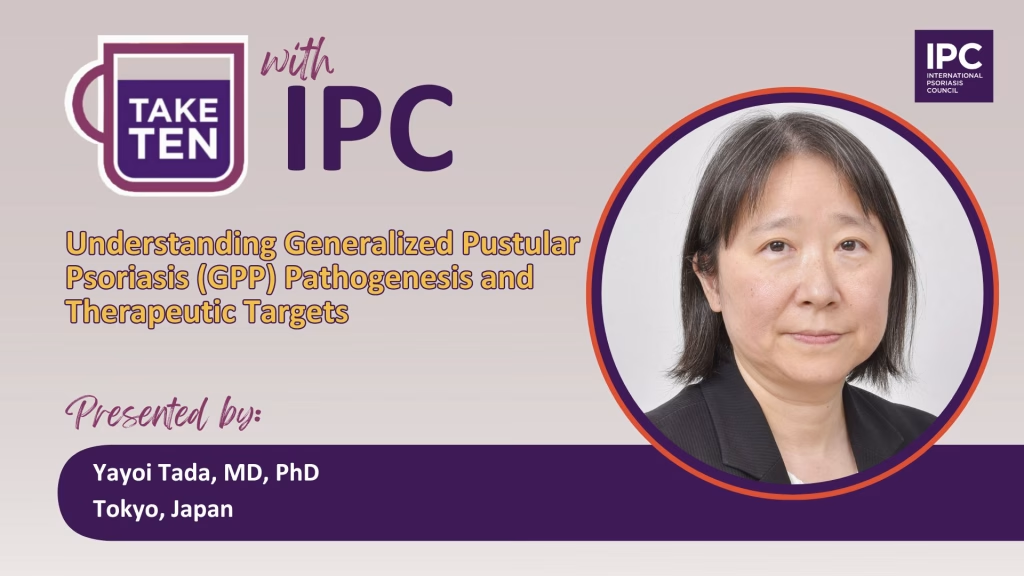
Generalized Pustular Psoriasis
OVERVIEW OF GENERALIZED PUSTULAR PSORIASIS
Generalized pustular psoriasis (GPP) is a rare and potentially life-threatening form of psoriasis that can present at any age, but the median age is around 50. GPP is characterized by widespread areas of inflamed skin with pustules, and its severity can fluctuate, with periods of flare-ups followed by remission. Flares may be triggered by multiple factors, such as rapid withdrawal of systemic corticosteroids, infections, pregnancy, and even stress.
The etiology of GPP is not fully understood. However, it is believed to involve a combination of genetic (e.g., IL36RN), environmental, and immune system factors (e.g., higher levels of IL-1 and IL-36, lower levels of IL-17A and INF-gamma than in psoriasis). The only approved treatment option for GPP is spesolimab (intravenous and subcutaneous). Intravenous spesolimab is approved for flares in some countries (e.g., US, Japan, China, Taiwan, and Canada). While subcutaneous spesolimab has been approved for flare prevention in the US and China. Other treatment options include non-biologic and biologic systemic therapies. The role of the IL-36 pathway as a key inflammatory factor in GPP is currently driving the development of new treatments.
IPC initiated the GPP consensus project to establish a standardized framework for diagnosing GPP, thereby enhancing clinical practices and promoting global research comparability. An extensive review and deliberation process was conducted using the modified Delphi method to redefine the diagnostic criteria for GPP.
Consensus Definition of GPP: Generalized Pustular Psoriasis (GPP) is a systemic inflammatory disease characterized by cutaneous erythema and macroscopically visible sterile pustules.
Fast Facts
- GPP is a rare and potentially life-threatening form of psoriasis.
- GPP-specific assessment tools, Generalized Pustular Psoriasis Area and Severity Index (GPPASI) and the Generalized Pustular Psoriasis Physician Global Assessment (GPPGA), have been developed and validated, showing they are valid, reliable, and responsive measures.
- There is only one approved GPP-specific treatment (intravenous and subcutaneous spesolimab) in several countries, either for flares or flare prevention, respectively.
- New GPP treatment options are being developed focused on the IL-36 pathway.
Latest Publications
Loading articles about psoriasis and generalized pustular psoriasis...
IPC Resources
PUBLICATIONS AND RESEARCH

IPC Generalized Pustular Psoriasis Training
The IPC GPP Training is a five-part educational series designed to provide clinicians with a practical foundation in the diagnosis, assessment, and evaluation of Generalized Pustular Psoriasis (GPP). Through a combination of expert-led educational videos and case-based exercises, participants will build confidence in recognizing and assessing GPP in clinical practice.
Additional Resources
VALIDATED SCORING TOOLS FOR GPP
GPP-specific assessment tools (i.e., Generalized Pustular Psoriasis Area and Severity Index (GPPASI) and Generalized Pustular Psoriasis Physician Global Assessment (GPPGA)) have been developed and validated.2, 3 The validation of GPPGA showed that the score effectively evaluates GPP severity, making it a valuable resource for clinicians and researchers in monitoring and managing this challenging condition.2 In addition, both GPPGA and GPPASI had psychometric validation, which showed they were valid, reliable, and responsive measures in assessing GPP disease severity.3
GPPGA score is based on the mean score of the three parameters assessed
(Image 1: GPPGA severity criteria | Image 2: GPPGA score)
- Clear: 0 if the mean score is 0
- Almost Clear: 1 if the mean score is > 1 and < 1.5
- Mild: 2 if the mean score is ≥ 1.5 and < 2.5
- Moderate: 3 if the mean score is ≥ 2.5 and < 3.5
- Severe: 4 if the mean score is ≥ 3.5
GPPASI (is based on a numeric score for a patient’s overall disease state, with a range of 0–72
(Image 3: GPPASI score)
- The GPPASI score is a measure of the average redness, pustulation, and scaliness of GPP lesions (each graded on a scale of 0–4), weighted by the area of involvement in four regions (head 10%, upper limbs 20%, trunk 30%, and lower limbs 40%)
OTHER SCORING TOOLS FOR GPP
JDA-GPPSI4
- The Japanese Dermatological Association Severity Index of GPP (JDA-GPPSI) can assess GPP severity based on skin symptoms and systemic involvement.
- The JDA-GPPSI classifies disease severity as mild (0–6), moderate (7–10), or severe (11–17)
- Validation is still needed.
PUBLICATIONS AND RESEARCH
Economic Burden of Generalized Pustular Psoriasis: A Population-based Register Study in Finland. Teitsma X, Huilaja L, Koivusalo M, et al. Acta Derm Venereol. 2026 Feb 10;106:adv44671. doi: 10.2340/actadv.v106.44671. PMID: 41665271; PMCID: PMC12905632.
This study assesses the economic burden of generalized pustular psoriasis, showing that disease flares are associated with substantially increased healthcare costs and resource utilization, underscoring the high clinical and financial impact of this severe psoriasis subtype.
Clinical Differentiation Between Acute Generalized Exanthematous Pustulosis (AGEP) and Generalized Pustular Psoriasis (GPP): A Multi-Center Study. Guo S, Wang X, Cheng W, et al. Chin Med J (Engl). Published online December 24, 2025. doi:10.1097/CM9.0000000000003812
Provides clinical criteria to distinguish AGEP from GPP, improving diagnostic accuracy in complex cases.
Generalized Pustular Psoriasis Confers Increased Risk of Pyoderma Gangrenosum (PG): First Population-Based Evidence. Ye H, Patel JD, Mohammad AP, et al. Dermatology. Published online December 11, 2025. doi:10.1159/000550044
Demonstrates the elevated risk of pyoderma gangrenosum in patients with GPP, highlighting comorbidity considerations
Mortality, Prevalence, Comorbidity, and Flare Patterns in Generalised Pustular Psoriasis: A Comprehensive Literature Review. Navarini AA, Pagotto A, Langford B, et al. Eur J Dermatol. 2025 Dec 1;35(6):459-470. doi: 10.1684/ejd.2025.4998. PMID: 41608917.
This literature review examines generalized pustular psoriasis as a rare, relapsing inflammatory disease, characterizes its flares, comorbidities, and disease burden, and highlights the need for improved recognition and management of this severe psoriasis subtype.
Spesolimab Rapidly Resolved Capillary Leak Syndrome (CLS) Associated with Generalized Pustular Psoriasis (GPP). Okada, Y, Kamata, M, Hayashi, K, et al. cta Dermato-Venereologica, 105, adv–2025. https://doi.org/10.2340/actadv.v105.adv-2025-0012
Reports the successful use of spesolimab to treat capillary leak syndrome in GPP patients, emphasizing targeted therapy potential.
Long-Term Efficacy and Safety Analysis of Secukinumab in the Treatment of Pediatric Generalized Pustular Psoriasis: A Real-World Study. Xing L, Long L, Wu T, et al. J Dermatolog Treat. 2025;36(1):2443121. doi:10.1080/09546634.2024.2443121
Evaluates long-term outcomes of secukinumab in pediatric GPP, supporting its safety and sustained efficacy in real-world practice.
Global Delphi Consensus on Treatment Goals for Generalized Pustular Psoriasis Barker J, Casanova E, Choon SE, et al. British Journal of Dermatology, Volume 192, Issue 4, April 2025, Pages 706–716, https://doi.org/10.1093/bjd/ljae491
Establishes international expert consensus on treatment objectives for GPP, guiding standardized care strategies.
Considerations for Treating Generalized Pustular Psoriasis (GPP): A Narrative Review Lynde C, Prajapati VH, Gooderham M, et al. Dermatol Ther (Heidelb) (2025). https://doi.org/10.1007/s13555-025-01535-7
Summarizes current treatment approaches and practical considerations for managing GPP in clinical practice.
Just the Facts: Diagnosis and Management of Generalized Pustular Psoriasis Yeung J, Prajapati VH, Mutter E. et al. Can J Emerg Med (2025). https://doi.org/10.1007/s43678-025-00883-9
Provides a concise overview of diagnostic criteria and management strategies for GPP.
What’s Inside IPC’s New Consensus Statement on GPP? TDD Talks to IPC’s Chief Medical Officer, Dr. Peter van de Kerkhof. The Dermatology Digest. June 6, 2024. Available from: https://thedermdigest.com/whats-inside-ipcs-new-consensus-statement-on-gpp-tdd-talks-to-ipcs-chief-medical-officer-dr-peter-van-de-kerkhof/
Highlights key points from IPC’s consensus statement on GPP, focusing on clinical guidance and expert perspectives.
IPC Consensus on Diagnosing Generalized Pustular Psoriasis Streamline Clinical Decision-Making. Jesitus J. Medscape. May 8, 2024.
Outlines IPC recommendations for diagnosing GPP to improve clinical decision-making and patient outcomes.
Efficacy and Safety of Subcutaneous Spesolimab for the Prevention of Generalised Pustular Psoriasis Flares (Effisayil 2): An International, Multicentre, Randomised, Placebo-controlled Trial. Morita A, Strober B, Burden AD, et al. Lancet. Oct 28, 2023;402(10412):1541-1551. doi: 10.1016/S0140-6736(23)01378-8.
Provides high-level evidence that spesolimab effectively prevents GPP flares with an acceptable safety profile.
Generalized Pustular Psoriasis: A Global Delphi Consensus on Clinical Course, Diagnosis, Treatment Goals and Disease Management. Puig L, Choon SE, Gottlieb AB, et al. J Eur Acad Dermatol Venereol. 2023;37(4):737-52. https://doi.org/10.1111/jdv.18851
Establishes consensus on GPP diagnosis, disease trajectory, and treatment priorities to guide clinical practice.
Generalized Pustular Psoriasis: A Review on Clinical Characteristics, Diagnosis, and Treatment. Rivera-Diaz R, Dauden E, Carrascosa JM, et al. Dermatol Ther (Heidelb). 2023;13(3):673-88. doi:10.1007/s13555-022-00881-0
Reviews the epidemiology, clinical presentation, and management options for GPP.
The Generalized Pustular Psoriasis Physician Global Assessment (GPPGA) Score: Online Assessment and Validation Study of a Specific Measure of GPP Disease Activity. Burden AD, Bachelez H, Choon SE, et al. Br J Dermatol. 2023;189(1):138-40. https://doi.org/10.1093/bjd/ljad071
Introduces and validates a disease-specific tool for assessing GPP activity in clinical settings.
Psychometric Validation of the Generalized Pustular Psoriasis Physician Global Assessment (GPPGA) and Generalized Pustular Psoriasis Area and Severity Index (GPPASI). Burden AD, Bissonnette R, Lebwohl MG, et al. J Eur Acad Dermatol Venereol. 2023; 37: 1327–1335. https://doi.org/10.1111/jdv.18999
Confirms the reliability and accuracy of two validated measures for evaluating GPP severity.
Design of Effisayil 2: A Randomized, Double-Blind, Placebo-Controlled Study of Spesolimab in Preventing Flares in Patients with Generalized Pustular Psoriasis. Morita A, Choon SE, Bachelez H, et al. Dermatol Ther (Heidelb). 2023;13(1):347-359. doi:10.1007/s13555-022-00835-6
Details the design and methodology of a pivotal trial evaluating spesolimab for GPP flare prevention.
Clinical Disease Measures in Generalized Pustular Psoriasis. Burden AD, Choon SE, Gottlieb AB, et al. Am J Clin Dermatol. 2022;23(Suppl 1):39-50. doi:10.1007/s40257-021-00653-0
Summarizes tools and metrics used to assess disease severity and progression in GPP.
Trial of Spesolimab for Generalized Pustular Psoriasis. Bachelez H, Choon SE, Marrakchi S, et al. N Engl J Med. Dec 23, 2021;385(26):2431-2440. doi: 10.1056/NEJMoa2111563.PMID: 34936739.
Reports a landmark clinical trial demonstrating the efficacy of spesolimab in treating GPP flares.
Adalimumab Treatment in Japanese Patients with Generalized Pustular Psoriasis: Results of an Open-label Phase 3 Study. Morita A, Yamazaki F, Matsuyama T, et al. J Dermatol. 45: 1371-1380. https://doi.org/10.1111/1346-8138.14664
Provides evidence for the effectiveness of adalimumab in Japanese patients with GPP.
European Consensus Statement on Phenotypes of Pustular Psoriasis. Navarini AA, Burden AD, Capon F, et al. J Eur Acad Dermatol Venereol. J Eur Acad Dermatol Venereol. 2017;31(11):1792-1799. doi:10.1111/jdv.14386
Establishes European expert consensus on the classification and phenotypes of pustular psoriasis.
WEBSITES
Generalised Pustular Psoriasis. DermNet website. Last updated 2022. Available from: https://dermnetnz.org/topics/generalised-pustular-psoriasis
A clinical overview of generalized pustular psoriasis, including causes, presentation, and management strategies.
IRASPEN Registry: International Rare and Severe Psoriasis Expert Network. International Rare and Severe Psoriasis Expert Network (IRASPEN) website. Last updated January 17, 2026. Available from: https://www.iraspen.org/en/
A comprehensive international network providing data and insights on rare and severe forms of psoriasis.
Pustular Psoriasis. National Psoriasis Foundation (NPF) website. Last updated March 27, 2025. Available from: https://www.psoriasis.org/pustular
An informative resource from the National Psoriasis Foundation detailing symptoms, treatment options, and patient guidance for pustular psoriasis.
Pustular Psoriasis Research Progress. Global Psoriasis Atlas website. Last updated October 29, 2025. Available from: https://www.globalpsoriasisatlas.org/en/resources/articles/article-pustular-psoriasis-research-progress
An article summarizing recent advancements in the study and understanding of pustular psoriasis.
References
- Clinical Disease Measures in Generalized Pustular Psoriasis. Burden AD, Choon SE, Gottlieb AB, Navarini AA, Warren RB. Am J Clin Dermatol. 2022;23(Suppl 1):39-50.
- The Generalized Pustular Psoriasis Physician Global Assessment (GPPGA) score: online assessment and validation study of a specific measure of GPP disease activity. Burden AD, Bachelez H, Choon SE, Marrakchi S, Tsai TF, Turki H, et al. Br J Dermatol. 2023;189(1):138-40.
- Psychometric validation of the generalized pustular psoriasis physician global assessment (GPPGA) and generalized pustular psoriasis area and severity index (GPPASI). Burden AD, Bissonnette R, Lebwohl MG, Gloede T, Anatchkova M, Budhiarso I, et al. J Eur Acad Dermatol Venereol. 2023;37(7):1327-35.
- Adalimumab treatment in Japanese patients with generalized pustular psoriasis: Results of an open-label phase 3 study. Morita A, Yamazaki F, Matsuyama T, Takahashi K, Arai S, Asahina A, et al. J Dermatol. 2018;45(12):1371-80.
Page last updated: April 2026