- IPC GENERAL
- IPC News, Psoriasis Around the World

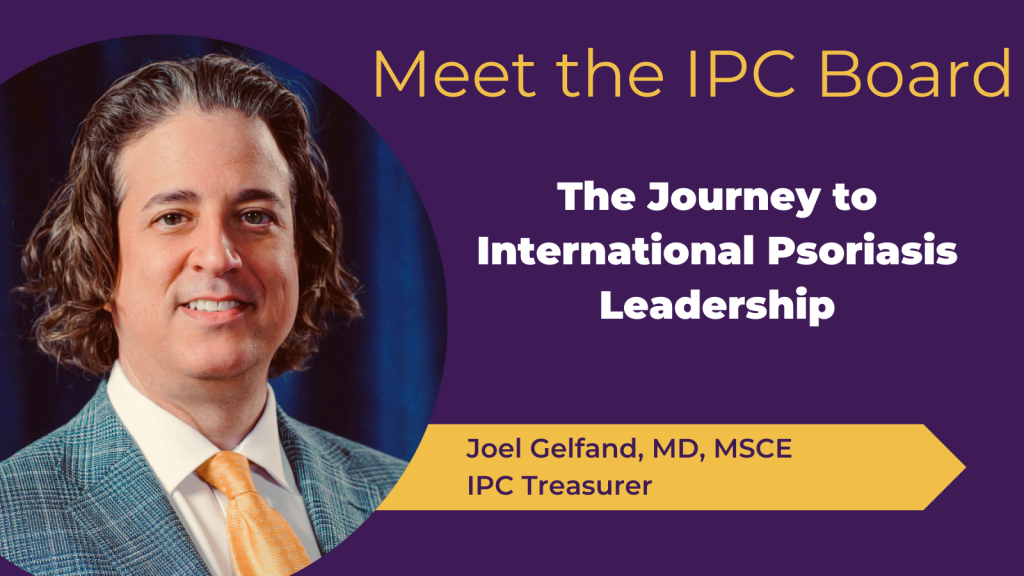
Joel Gelfand, MD, MSCE
University of Pennsylvania
Philadelphia, Pennsylvania, United States
IPC Treasurer
- Joel Gelfand, based in Philadelphia, Pennsylvania, is the Treasurer on the Board of the International Psoriasis Council.
- He earned his medical degree at Harvard Medical School, taking a year off to work on clinical research with Dr. Mark Lebowohl at Mount Sinai in New York City.
- Gelfand is the author of over 260 scientific publications, editorials, reviews, and textbook chapters (cited over 18,000 times, H index 60), which appear in journals such as JAMA, BMJ, European Heart Journal, Annals of Rheumatic Disease, JAMA Dermatology, JAAD, and the JID.
- He has been a Board Member of the International Psoriasis Council (IPC) Since 2020 and is a vital leader of the IPC Fellowship Program Advisory Committee and IPC Executive Committee.
As a dermatologist, epidemiologist, and tenured professor at the University of Pennsylvania Perelman School of Medicine, Dr. Joel Gelfand manages a substantial clinical, epidemiological, and translational research program on psoriasis. His efforts are supported by funding from the National Institutes of Health (NIH), the Patient-Centered Outcomes Research Institute (PCORI), the National Psoriasis Foundation (NPF), and various investigator-initiated, independent grants from the industry. Dr. Gelfand holds the position of Director at the Psoriasis and Phototherapy Treatment Center at the University of Pennsylvania (Penn), where his focus lies in enhancing psoriasis patient outcomes in both the skin and joints while also reducing their risk of diabetes, cardiovascular disease, and mortality. A member of IPC since January 2011 and a member of the Board of Directors since January 2020, Dr. Gelfand assumed the role of Treasurer in 2022.
“The best part of IPC has been the opportunity to collaborate with outstanding Fellows from around the world..."
— Joel Gelfand, MD, MSCE, Treasurer
Reflecting on his medical student years at Harvard, Dr. Gelfand recalls, ” I had zero interest in dermatology. Then, when I was on clinical rotations, I fell in love with the specialty. I was especially interested in HIV-associated skin problems.” Intrigued by the courage displayed by patients dealing with chronic and often stigmatizing conditions, poorly understood by the broader medical community and society, Dr. Gelfand’s interest in clinical research led him to collaborate with Dr. Mark Lebowohl at Mount Sinai in NYC during a year off from medical school.
As a medical student, Dr. Gelfand applied for grants to support a study that he designed and executed, evaluating the impact of UVB phototherapy on levels of HIV in the blood measured by PCR. “At the time, it was thought UV light would increase HIV replication based on mouse models,” he notes. The results of his study were published in the Archives of Dermatology (Now JAMA Dermatology), solidifying his commitment to a career in clinical investigation in dermatology.1
Surviving a serious form of cancer during adolescence profoundly influenced Dr. Gelfand. Treated at a major academic medical center, this experience imprinted on him the importance of academic medicine. “We are the physicians of last resort, treat the most challenging cases, and offer hope for those near and far,” he shares. The visible effects of cancer treatment struck a chord when, as a medical student at Harvard, patients with skin disease confided in him about the painful experiences of living with psoriasis and other conditions. Dr. Gelfand acknowledges the unique privilege dermatologists have in helping patients lead healthier, fuller lives.
Throughout his career, Dr. Gelfand has been fortunate to have outstanding mentors at every stage, including David Cochrane at Tufts, Daniel Singer, Dick Johnson, and Rob Stern at Harvard, Mark Lebwohl and Mary Klotman at Mount Sinai, and Brian Strom and David Margolis at Penn.
“In the Western world, particularly in the United States, access to outstanding treatments for psoriasis is often taken for granted.” Dr. Gelfand acknowledges IPC’s crucial role in advocating for education, research, and patient care of psoriasis on a global scale. Reflecting on this, he emphasizes, “IPC’s role becomes even more crucial in advocating for education, research, and patient care of psoriasis worldwide.”
“The best part of IPC”, he affirms, “has been the opportunity to collaborate with outstanding Fellows from around the world, such as Alvaro Gonzalez Cantero (Spain), Filip Rob (Czech Republic), Juul Van den Reek (Netherlands), and Netsanet Gebeyehu (Ethiopia).”
Reference:
- Effect of UV-B Phototherapy on Plasma HIV Type 1 RNA Viral Level: A Self-controlled Prospective Study. Gelfand JM, Rudikoff D, Lebwohl M, Klotman ME. Arch Dermatol. 1998 Aug;134(8):940-5. doi: 10.1001/archderm.134.8.940. PMID: 9722723.