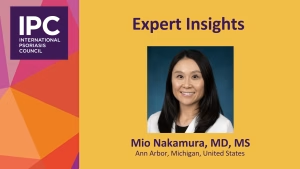

- Mio Nakamura, MD, MS
- Expert Insights, Quality of Life

Personality and Personality Disorders
A patient’s personality is often what makes each provider-patient interaction distinctive. Personality is the unique way of relating to self, others, and the world. In the medical setting, personality is important because it can affect how a patient presents with and manages their illness, relates to the clinician, and responds to treatments and procedures. Furthermore, personality features are often accentuated during times of stress, such as when one is ill or hospitalized. Therefore, as doctors, we often see the patient’s personality unmasked.
It is important for physicians to meet the patient’s personality. Personalities themselves may not change, so we must adjust our behavior to align with the patient’s perspectives. Specifically, we must make educated predictions about which comments and interventions may be best received, jeopardize the doctor-patient relationship, or facilitate collaboration toward optimal outcomes. However, this can be a challenge when a patient has a personality disorder or shows traits of certain personality disorders.
Patients with personality disorders may present unique communication and management challenges, as personality disorders are characterized by persistent patterns of thinking and behavior that can affect interpersonal relationships and medical interactions. As physicians, it can be challenging to connect with a patient with a personality disorder, as it can be difficult to see eye to eye with them, particularly when communication styles and expectations differ.
John Koo, MD, a board-certified dermatologist and psychiatrist, states, “When I think of the topic of difficult patients, I first think of patients with borderline personality disorder.” Borderline personality disorder (BPD) is characterized by a pattern of instability in interpersonal relationships, self-image, and affect. People with BPD exhibit a phenomenon called “splitting,” which is a polarizing way of categorizing others as either wholly good or wholly bad. In addition, they often have labile moods and intense emotions. They can show impulsive behavior, including self-harm, suicide attempts, substance abuse, and risky sexual behaviors.
In the medical setting, a patient with BPD will often show marked instability in how they experience their illness, and they can be strikingly emotional about the medical condition. There is also instability in their relationship with the physician. They often distrust health care providers because they have been perceived as dismissive and less attentive than they feel their condition warrants. They have likely seen many different doctors. Some may have had difficult experiences with previous practices. Prior providers who did not meet their needs medically and/or emotionally are often “split” and viewed negatively.
When approaching patients with BPD, it is important to recognize that their emotions and behaviors are due to fear of abandonment. We must be careful not to minimize their condition and to empathize with any emotional component of their disease, even if it seems out of proportion. Because these patients often feel abandoned, scheduling frequent follow-up appointments may help to promote a positive doctor–patient relationship. Although such patients are sometimes demanding, it is important not to provide unnecessary treatments or perform unnecessary procedures. Reasoning with these patients may sometimes be less effective and could leave the provider feeling negatively “split.” Instead, empathize with their concerns and acknowledge their perspective when explaining your management plan.
As illustrated in this example with BPD, if we can identify traits of a specific personality disorder and understand the underlying psychopathology, we can effectively adjust our demeanor, interactions, and medical management plan to align with the patient.
The Oppositional Patient
Although patients with personality disorders can present unique challenges, Dr. Koo finds there is another, much more prevalent category of “difficult” patients. These patients may be labeled as the “oppositional” or “yes, but…” type. In the case of psoriasis, a dermatology provider may spend extensive time and effort discussing various treatment options, yet the patient remains preoccupied with possible side effects. In the end, it can be challenging when such a patient declines all options offered.
“I used to think that such patients are difficult patients. However, I have changed my mind when I realized that they are more likely to be ‘uninformed’ or ‘inadequately informed’ patients rather than ‘difficult’ patients.” Dr. Koo noticed that these patients quickly accept therapy once they are informed of the risk of no treatment or inadequate treatment of psoriasis. “We all know that even mild psoriasis has been documented to increase cardiovascular risks compared to somebody with no psoriasis, and this risk becomes higher if the psoriasis is more severe. I became aware of the fact that most of my patients have no idea regarding the comorbidities of untreated or inadequately treated psoriasis, ranging from metabolic syndrome to depression/anxiety to a whole host of other conditions. Once patients are properly educated regarding the risks of inadequate or no treatment, these “difficult” patients quickly became not difficult anymore.”
“Difficult” Patient: Just a Label
Patients can be labeled “difficult” for various reasons, including personality traits, misinformation, or lack of information. With every patient, there are a few key tips to remember. First, a provider must recognize why the patient may be perceived as “difficult.” Next, the provider must understand the underlying reason for the disconnect. Lastly, we must adjust our communication and behavior accordingly and meet them where they are. If we can see eye to eye with the patient, they are no longer “difficult,” and we can provide the appropriate care they need.
References
- Personality Disorders in Dermatology: A Review of Patient Characteristics, Associated Dermatologic Conditions, and Pearls for Management. Reynolds KA, Rew J, Nakamura M. Clin Dermatol. 2023;41(1):105-111. doi:10.1016/j.clindermatol.2023.03.009.
- Personality Disorders and the “Difficult” Dermatology Patient: Maximizing Patient Satisfaction. Nakamura M, Koo J. Clin Dermatol. 2017;35(3):312-318. doi:10.1016/j.clindermatol.2017.01.009.