
- Towhida Noor, MBBS, MD
- Expert Insights, Genetics, Pathophysiology, & Epidemiology, Research, Treatment, Types of Psoriasis

Currently, the treatment of psoriasis comprises topical treatment, with roflumilast and tapinarof as recent innovations, phototherapy with ultraviolet B (UVB) and photochemotherapy, classical systemics (methotrexate, cyclosporine, acitretin, and dimethyl fumarate), targeted therapy with apremilast, deucravacitinib as small molecules and biologics with different targets: anti-TNF therapies (etanercept, adalimumab, infliximab, and certolizumab), the anti-IL-17 (secukinumab, ixekizumab, brodalumab, and bimekizumab) and anti-IL-23 molecules (guselkumab, tildrakizumab, risankizumab), with the latest addition of the oral IL-23 inhibitor, icotrokinra. This spectrum of treatments permits personalized care for many patients, with about 50% reaching clear skin.
The unmet need in the treatment of psoriasis remains the achievement of clear skin as a long-term goal, including for patients with difficult-to-treat psoriasis. In a disease as heterogeneous as psoriasis, innovative treatments that broaden the spectrum of therapeutic interventions are important, either by improving targeted treatments with molecules that have optimal pharmacodynamic characteristics or by employing entirely new principles.
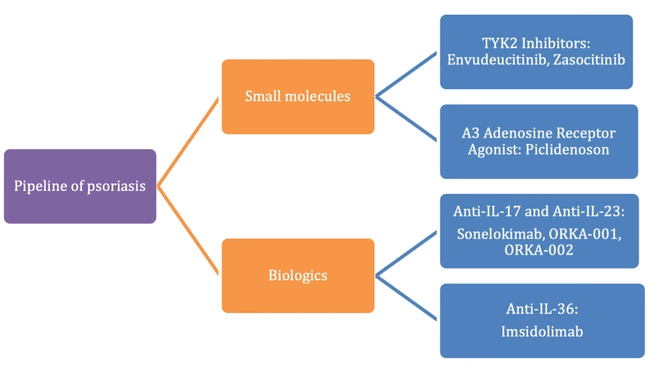
The newest additions to the psoriasis treatment are just around the corner. Figure 1 summarizes these innovations.
Advanced TYK2 Inhibitors
Envudeucitinib (ESK-001)
It is a highly selective allosteric TYK2 inhibitor next to deucravacitinib.1 It is indicated for moderate to severe psoriasis with a dosage of 40 mg twice daily. The molecular structure is similar to deucravacitinib, with an improved safety profile. It has a deuterated methyl triazole and a cyclopropyl carboxamide group that enhance its stability and cardiac safety. It binds selectively to the pseudokinase JH2 domain to inactivate the TYK2 JH1 domain while preserving the JAK1/2/3 activity. Consequently, adverse effects on hematopoietic functions or serum lipid levels and major adverse cardiovascular events were not observed during the phase 2 trial, the STRIDE study.2,3 At week 12, PASI 90 or greater was reached in 38.5% of patients, and PASI 100 in 15.4% of patients.2 At week 52, PASI 90 was reached by 61% and PASI 100 by 39% of patients. During the phase 2 trial, no deaths, tuberculosis, herpes zoster, opportunistic infections, or oral ulcers were reported. Only 2.6% of patients discontinued treatment due to adverse effects of headache, upper respiratory tract infection, and nasopharyngitis.
The Phase 3 studies (ONWARD1 and ONWARD2) of envudeucitinib demonstrated rapid and sustained skin clearance in moderate to severe plaque psoriasis, with approximately 65% achieving PASI 90 and over 40% reaching complete clearance (PASI 100) by week 24. Long-term extension data at 48 weeks maintained high efficacy, with a 54% PASI 100 rate in the continuous-treatment cohort.4 These studies demonstrated its safety for long-term use.
Zasocitinib (TAK-279)
Zasocitinib is also an allosteric TYK2 inhibitor. It has been bioengineered to enhance its selectivity for the TYK2 JH2 domain. It has a 1-millionfold greater selectivity for TYK2 than for other Janus kinase enzymes. It is an oral drug with once-daily dosing, with superior efficacy and a longer duration of effect than deucravacitinib. In the phase 2b study, 30 mg zasocitinib resulted in 46% of patients achieving PASI 90 and 33% achieving PASI 100 after 12 weeks. Improvement in psoriasis was observed as early as two weeks and was maintained up to 12 weeks, irrespective of body site. Treatment-emergent adverse events occurred in 53% to 62% of treated patients (vs. 44% for placebo) with no dose dependency and a favorable profile lacking typical broad JAK inhibitor toxicities due to its high selectivity for the TYK2 JH2 domain.5
The Phase 3 LATITUDE program for zasocitinib (TAK-279) evaluated the drug across multiple global, randomized, double-blind trials, most notably the LATITUDE PsO 3001 and 3002 sister studies (comparing it to placebo and apremilast) and the head-to-head LATITUDE Atlas trial (comparing it directly to deucravacitinib).6,7 At week 16, PASI 90 was reached by 52% to 61% of patients, and PASI 100 by 25% to 33%.
Zasocitinib demonstrated statistical superiority over deucravacitinib for its primary endpoint. By week 16, 35% of patients receiving zasocitinib achieved complete skin clearance (PASI 100), which was roughly 2.5 times the response rate of deucravacitinib. Across the Phase 3 program involving nearly 3,000 patients, zasocitinib was generally well tolerated. The most frequent adverse effects were upper respiratory tract infections (10%), acne (6.5%), and nasopharyngitis (6.2%).
The A3 Adenosine Receptor (A3AR) Agonist Piclidenoson
A3AR is a Gi protein-associated cell surface receptor, one of the adenosine receptor family. This receptor is overexpressed in inflammatory cells, but not in normal cells. Piclidenoson induces an anti-inflammatory effect by downregulating the NF-κB signaling pathway, resulting in the dysregulation of proinflammatory cytokines and chemokines, including IL-1, IL-8, TNF-α, and MIP-1α. It also induces apoptosis of inflammatory cells and inhibits the proliferation of autoreactive T cells.
The phase 2 trial demonstrated a slower onset of efficacy, with greater efficacy beyond 12 weeks. While early timelines (week 12 or 16) typically failed to reach statistical significance for clearance, extending treatment duration revealed clear cumulative efficacy. By week 32 of treatment, 25% of patients achieved PASI 90, and 11% achieved PASI 100. The drug showed an excellent safety profile, with adverse event rates comparable to those of the placebo group.8
The phase 3 placebo- and apremilast-controlled trial (COMFORT-1) showed that the 3 mg twice-daily dose was adequate to achieve PASI 75 at week 16.9 Both the 2 mg and 3 mg twice-daily doses showed clinically equivalent, linear improvements in efficacy that continued to increase the longer patients stayed on treatment. Noninferiority compared to apremilast (Otezla) was demonstrated for PASI 75 with the 2 mg twice-daily dose at week 32. The drug is still undergoing a pivotal phase 3 trial and is not yet approved by the United States Food and Drug Administration (FDA).
Anti-IL-17 and Anti-IL-23
Sonelokimab
Sonelokimab consists of three variable domains (VHH). Two of these domains bind IL-17A and IL-17F with high affinity. This allows it to block all dimer combinations: IL-17A/A, IL-17F/F, and the IL-17A/F heterodimer. Sonelokimab has a much lower molecular weight (approximately 40 kDa) compared with traditional mAbs (approximately 150 kDa). This smaller size allows it to penetrate deeply and accumulate more effectively within difficult-to-reach, deep dermal inflamed tissues.
In a Phase 2b trial, it delivered rapid and durable skin clearance (PASI 90/100), outperforming placebos and demonstrating superior efficacy compared to some currently approved single-target IL-17A inhibitors.10 In the IZAR-1 trial targeting psoriatic arthritis, the skin results revealed phase 3 data from patients who entered the trial with concomitant skin involvement, with 61% achieving PASI 90 by week 16. 11
Sonelokimab has a favorable and predictable safety profile consistent with its IL-17 mechanism of action. Reported adverse events included mild to moderate upper respiratory infections, headaches, injection-site reactions (erythema), and Candida infections. Over 52 weeks, Candida infections occurred in 7.4% of participants in the sonelokimab-containing groups compared with 1.9% in the secukinumab group. Across trials, no cases of inflammatory bowel disease (IBD), major adverse cardiovascular events (MACE), suicidal ideation/behavior (SIB), serious systemic infections, or malignancies were reported.10
ORKA-001
The drug has generated significant momentum, as it could shift the biologic paradigm from one to two monthly maintenance injections to annual or semiannual dosing. It is a monoclonal antibody designed to inhibit IL-23p19. It is a humanized IgG1 antibody engineered to retain risankizumab-like epitope specificity and inhibitory function in vitro. This Fc engineering has extended its half-life by threefold compared with risankizumab, and IL-23-dependent STAT3 signal suppression is observed for up to 24 weeks. ORKA-001 is specifically designed to achieve extended, off-treatment long-term remission for patients with moderate to severe plaque psoriasis. Rather than requiring lifelong continuous dosing every few weeks or months, its target profile focuses on long-lasting disease control with highly infrequent maintenance. Phase 1 data showed that after just a single 600 mg dose, antibody concentrations remained well above effective trough levels for a full 12 months, driving sustained inhibition of the IL-23 signaling pathway.12 In the Phase 2 EVERLAST-A trial, PASI 100 was reached by 63% of patients and PASI 90 by 83% of patients by week 16. 13 No serious adverse effects were observed. The most common adverse events were mild headache, upper respiratory tract infections, and transient injection site erythema. Ongoing clinical development aims to determine whether high-dose, long-acting IL-23 inhibition can enable prolonged remission with infrequent or no maintenance dosing, challenging current paradigms of lifelong continuous therapy in psoriasis.14
ORKA-002
This drug has also created the momentum of a potential shift to annual or semi-annual dosing. It is a monoclonal antibody designed to inhibit IL-17A/F. The distinguishing feature of ORKA-002 is its engineered Fc region, which extends its serum half-life to 75 to 80 days. While current IL-17 inhibitors generally require monthly or bimonthly maintenance shots, ORKA-002’s long half-life is designed to allow for maintenance dosing only two to three times a year (every four to six months). The Phase 1 trial showed sustained IL-17 inhibition and a favorable safety profile with no serious adverse events.15 Phase 2 results are expected in 2027.
Anti-IL-36
Imsidolimab
Generalized pustular psoriasis (GPP) is a rare, chronic, life-threatening autoinflammatory skin disease in which most cases are due to a single gene defect identified as various consequential genetic variants in the IL36RN gene, encoding the IL-36 receptor antagonist. Imsidolimab is a high-affinity, humanized immunoglobulin G4 monoclonal antibody that binds to the IL-36 receptor, antagonizing IL-36 signaling. Regarding safety concerns, imsidolimab has a low incidence of infections. Administration is also favorable for imsidolimab; the initial dose is given as an intravenous infusion over 60 minutes, followed by maintenance via subcutaneous injection.
In a phase 2 open-label, single-arm, multiple-dose study, patients with GPP were treated with imsidolimab to assess clinical efficacy, tolerability, and safety. 16 Patients received an intravenous dose of imsidolimab 750 mg on day 1, followed by three subcutaneous doses of imsidolimab 100 mg administered on days 29, 57, and 85. Eight patients were enrolled, and six completed the study. Responses were observed as early as day 3, most rapidly for pustulation relative to other manifestations of GPP, with continued and consistent improvement across multiple efficacy assessments at day 8, day 29, and through day 113. GEMINI-1 was a double-blind, placebo-controlled trial that randomly assigned 45 patients (18–80 years of age) with a GPP flare to receive either a single intravenous dose of 300 mg of imsidolimab, 750 mg of imsidolimab, or placebo.17 The primary endpoint was GPP Physician Global Assessment (GPPPGA) scores of clear (0) or almost clear (1) at week 4 (range: 0 [clear] to 4 [severe]). GEMINI-2 was a follow-on relapse-prevention trial with a primary objective of evaluating the safety of imsidolimab up to 104 weeks.17 In GEMINI-2, there were no serious adverse events leading to treatment discontinuation with imsidolimab through 104 weeks of treatment.
References
- Envudeucitinib, a Potent, Next-Generation, Allosteric Inhibitor of TYK2: A Narrative Review. Armstrong AW, Krueger JG, Strober BE, et al. Dermatol Ther (Heidelb). 2026;16(6):2661-2673. doi:10.1007/s13555-026-01727-9
- Highly Selective, Allosteric Inhibition of TYK2 with Oral ESK-001 in Patients with Moderate-to-Severe Plaque Psoriasis: Results from STRIDE, a 12-Week, Randomized, Double-Blinded, Placebo-Controlled, Dose-Ranging Phase 2 Study. Blauvelt A, Arenberger P, Sauder MB, et al; STRIDE Investigators. J Am Acad Dermatol. 2026;94(1):57-65. doi:10.1016/j.jaad.2025.07.013
- Safety and Efficacy of Envudeucitinib, a Highly Selective, Oral Allosteric TYK2 Inhibitor, in Patients with Moderate-to-Severe Plaque Psoriasis: Results from the 52-Week Open-Label Extension Period of the Phase 2 STRIDE Study. Papp KA, Jacobs S, Sofen H, et al. J Am Acad Dermatol. 2026;94(1):187-195. doi:10.1016/j.jaad.2025.10.005
- Envudeucitinib Achieves 54% PASI 100 Rate at 48 Weeks in Phase 3 Extension. Heaning S. Dermatology Times. August 11, 2026. https://www.dermatologytimes.com/view/envudeucitinib-achieves-54-pasi-100-rate-at-48-weeks-in-phase-3-extension
- Zasocitinib (TAK-279), a Selective, Oral TYK2 Inhibitor, Reduces Body Surface Area Involvement in a Phase 2b Trial in Moderate-to-Severe Plaque Psoriasis. Laquer V, Kircik LH, Sadick N, et al. J Skin. 2024;8(6):s441. doi:10.25251/skin.8.supp.441
- Takeda’s Zasocitinib Demonstrates Consistent, High Rates of Skin Clearance across the Body, Including Hard-to-Treat and High-Impact Sites, in Phase 3 Psoriasis Studies. Takeda Pharmaceutical Company Limited. https://www.takeda.com/newsroom/newsreleases/2026/zasocitinib-phase-3-psoriasis-skin-clearance/
- Takeda’s Zasocitinib Significantly Outperforms Deucravacitinib in Head-to-Head Phase 3 Psoriasis Study, Promising to Redefine Oral Treatment Expectations. Takeda Pharmaceutical Company Limited. https://www.takeda.com/newsroom/newsreleases/2026/zasocitinib-outperforms-deucravacitinib-study/
- Treatment of Plaque-Type Psoriasis with Oral CF101: Data from an Exploratory Randomized Phase 2 Clinical Trial. David M, Akerman L, Ziv E, et al. J Eur Acad Dermatol Venereol. 2012;26(10):1244-1253. doi:10.1111/j.1468-3083.2011.04078
- Efficacy and Safety of Piclidenoson in Plaque Psoriasis: Results from a Randomized Phase 3 Clinical Trial (COMFORT-1). Papp KA, Beyska-Rizova S, Gantcheva ML, et al. J Eur Acad Dermatol Venereol. 2024;38(6):1112-1120. doi:10.1111/jdv.19811
- IL17A/F Nanobody Sonelokimab in Patients with Plaque Psoriasis: A Multicentre, Randomised, Placebo-Controlled, Phase 2b Study. Papp KA, Weinberg MA, Morris A, Reich K. Lancet. 2021;397(10284):1564-1575. doi:10.1016/S0140-6736(21)00440-2
- Sonelokimab Meets Primary End Point in Phase 3 Psoriatic Arthritis Trial. Heaning S. Dermatology Times. https://www.dermatologytimes.com/view/sonelokimab-meets-primary-end-point-in-phase-3-psoriatic-arthritis-trial
- Phase 1 Clinical Data of ORKA-001, a Novel Half-Life Extended IL-23p19 Monoclonal Antibody with Potential for Once-Yearly Dosing in Plaque Psoriasis. Krueger J, Wynne C, Lebwohl M, et al. J Skin. 2025;9(6):s634. doi:10.25251/w0x98v10
- EVERLAST-A: A Phase 2a Study Design of ORKA-001, a Novel Half-Life-Extended IL-23p19 Monoclonal Antibody for Plaque Psoriasis. Blauvelt A. Presented at: European Academy of Dermatology and Venereology (EADV) Congress; September 18, 2025; Paris, France. Abstract FC02.1
- High-Dose, Extended Half-Life IL-23 Inhibitors: The Next Big Step in Psoriasis Care? Torres T, Blauvelt A. Dermatol Ther (Heidelb). 2026;16(4):1841-1845. doi:10.1007/s13555-026-01707-z
- Oruka Therapeutics Announces Positive Interim Phase 1 Data for ORKA-002 and Initiation of EVERLAST-B Trial of ORKA-001. Oruka Therapeutics. https://ir.orukatx.com/news-releases/news-release-details/oruka-therapeutics-announces-positive-interim-phase-1-data-orka
- Imsidolimab, an Anti-Interleukin-36 Receptor Monoclonal Antibody, for the Treatment of Generalized Pustular Psoriasis: Results from the Phase 2 GALLOP Trial. Warren RB, Reich A, Kaszuba A, et al. Br J Dermatol. 2023;189(2):161-169. doi:10.1093/bjd/ljad083
- Efficacy and Safety of Imsidolimab for Generalized Pustular Psoriasis. Smieszek S, Przychodzen B, Tyner C, et al. NEJM Evid. 2026;5(5). doi:10.1056/EVIDoa2500272