International Psoriasis Council

Advancing Knowledge. Improving Care.

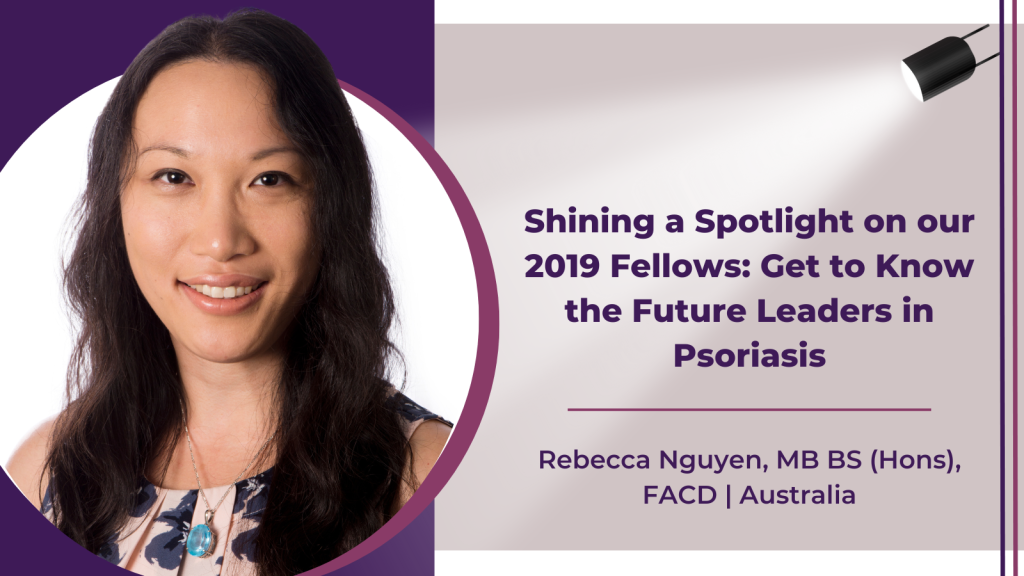
Shining a Spotlight: Catching up with 2019 IPC Fellow Rebecca Nguyen, MB BS (Hons), FACD

Rebecca Nguyen, MB BS (Hons), FACD

Skin Health Institute, Monash Health and Eastern Health

Kew East, Australia

IPC Jr. Councilor

Bio
The IPC Fellowship Experience

I had the privilege of working alongside IPC Councilor Professor Carle Paul at the Centre Hospitalier Universitaire in Toulouse, France, where we focused on treating and managing complex psoriasis patients in the inflammatory/medical dermatology clinics. Under Professor Paul’s mentorship, I gained a deep understanding of this niche field. I had the opportunity to attend clinical meetings, meet others involved in their clinical program, and attend a medical dermatology seminar with other visiting dermatologists in the department.

In addition, I attended the IPC Think Tank Meeting in Lisbon, Portugal, and the World Congress of Dermatology held in Milan, Italy, where I had the pleasure of meeting other Fellows in the program and the Councilors involved in the IPC. I was thrilled to hear many of them present their exciting and varied work on psoriasis. 

Post-Fellowship Achievements

After completing my Fellowship in 2019, I have been one of the consultants responsible for running the inflammatory dermatology clinics that treat eczema and psoriasis in our hospital institution in Melbourne, Australia. My main focus is teaching our dermatology trainees in the field, mentoring our junior colleagues, and continuing to be involved in dermatology clinical trials.

Applying Knowledge in the Field

Since completing the IPC Fellowship Program, I have actively engaged in medical education and mentoring junior colleagues. Over the last few years, I have been running online education sessions with current IPC Fellows and IPC Councilor Associate Professor Peter Foley on complex medical dermatology cases in psoriasis patients. During these sessions, we discuss different approaches to treatment and management, and it is gratifying to hear the insights of others and how we can improve our clinical care.

Apart from this, I have also been involved in medical education in my local institutions, regional areas, and the broader field of dermatology. I continue to mentor junior trainees in our dermatology program during our clinics, and it has been a fulfilling experience to see them grow and learn as healthcare professionals.

Navigating Career Challenges

Finding new clinical research opportunities and establishing collaboration networks are always challenging tasks. IPC’s Fellowship Program offers a platform for meeting colleagues and developing and sharing ideas on new projects as they evolve. I am thankful to the IPC for providing this opportunity, which has been a unique and valuable experience, especially for a young dermatologist like myself.

“IPC’s Fellowship Program offers a platform for meeting colleagues and developing and sharing ideas on new projects as they evolve. I am thankful to the IPC for providing this opportunity, which has been a unique and valuable experience, especially for a young dermatologist like myself.”

Evolving Perspectives on the Industry

The field of medical dermatology has experienced significant advancements in the last few years, with the emergence of various innovative treatments for difficult-to-treat conditions that were previously unavailable. Ongoing research and development have enabled us to improve our understanding of these conditions, leading to even better treatments currently in the pipeline for our patients. Dermatologists must keep informed about these advancements from various sources to provide excellent clinical care to their patients. This field will continue to evolve, and it is essential to stay up-to-date to provide the best possible care.

Advice for Future Fellowship Participants

Looking back, taking advantage of every opportunity that comes your way is crucial to increasing your involvement in different aspects of dermatology. This includes clinical work, medical education, and academic research. As a junior dermatologist, I have numerous opportunities for growth in all these areas, and it’s possible to carve out a subspecialty or niche area of interest. Building networks and connections is vital for collaboration and gaining a fresh perspective on challenges in your work. I am grateful for the chance I had early on to get involved in a program that taught me these skills.

If you are a young dermatologist or researcher passionate about improving the lives of people with psoriasis and want to expand your horizons, consider applying to participate in IPC’s International Fellowship Program. Applications for the 2025 program will open in September 2024.
Categories

Recent Posts

When Cancer and Psoriasis Coexist: New IPC Guidance Puts Clarity Where It Is Needed Most

Reframing Obesity in Psoriatic Disease: From Pharmacokinetic Barrier to Therapeutic Target

Psoriasis and Metabolic Health: What IPC’s Latest Publication Means for Clinical Practice

Also Read

A grid of eight professionally dressed people, four men and four women—each an IPC Fellowship participant—in individual portrait photos, set against a colorful geometric background.
Clinical psoriasis management

Meet IPC’s 2026 International Fellows

Meet the 2026 IPC International Fellows, eight internationally selected clinicians and researchers advancing evidence-based psoriasis care and global collaboration through the International Psoriasis Council.

Read More

Subscribe to the IPC Newsletter

Stay up-to-date on the latest research, news, and upcoming events right in your inbox.

What's New

When Your Patient with Psoriasis Is Diagnosed with Cancer

A patient doing well on an IL-17 inhibitor is diagnosed with cancer, and the oncologist wants the biologic stopped. It is a call most dermatologists have made without much to stand on: patients with cancer are excluded from psoriasis trials, so the entire evidence base is observational. A new IPC paper in JAAD Reviews takes a position anyway. Per the summary of product characteristics, active malignancy is not a contraindication to any biologic. IL-17 and IL-23p19 inhibitors are first-line, TNF inhibitors and deucravacitinib warrant caution, and cyclosporine is the one to avoid outright. The authors also warn that psoriasis severity is routinely underestimated once a patient is in oncology care: if they meet IPC’s criteria, they are a candidate for systemic therapy regardless of what else is on their problem list. “Too often, systemic psoriasis therapy is discontinued or never initiated in patients with cancer, even when the evidence supports safe and effective options,” says Paolo Gisondi, MD, IPC Councilor and lead author. The post includes the therapeutic options figure, designed as a reference for both specialties to work from, and a slide set for teaching and presentations.

READ NOW

Thursday, August 27, 2026

Apply Now: 2027 IPC International Fellowship Program

IPC is accepting applications for the 2027 International Fellowship Program, a 12-month opportunity for early-career dermatologists and researchers focused on psoriasis. Fellows are matched with IPC Board Members or Councilors for hands-on clinical or research experience, along with virtual mentoring, skills-development classes, and ongoing connections to IPC’s global network throughout the fellowship year. Applications are open until September 30, 2026.

APPLY NOW

Monday, August 31, 2026

IPC Generalized Pustular Psoriasis (GPP) Training Modules

Recognizing GPP in clinical practice can be a challenge, even for experienced dermatologists. IPC’s new five-part training series walks clinicians through the practical skills needed to diagnose and assess GPP with confidence: distinguishing it from plaque psoriasis and other mimicking conditions, and scoring its severity using tools such as the GPPGA and GPPASI. Each module pairs an expert-led video with a case-based exercise, and the series is built to be completed in sequence at your own pace. All five modules are free and open to everyone; watch the videos on your own or work through the assessments as you go. Score 80% or higher on each of the five assessments to earn a Certificate of Completion.

LEARN MORE

Thursday, August 13, 2026

IPC Summary Slides: Psoriasis and Metabolic Health

IPC has released a set of summary slides distilling the key findings from its recent publication on psoriasis and metabolic health, published in the Journal of the American Academy of Dermatology (JAAD). The paper outlines five priorities for improving cardiometabolic risk screening and care in patients with psoriasis. Designed for sharing, the slides give clinicians and colleagues an easy way to disseminate the findings.

LEARN MORE

Wednesday, August 5, 2026

Paradoxical Psoriasis - María Julia Cura, MD

In this Take Ten with IPC video, IPC Junior Councilor Dr. María Julia Cura discusses paradoxical psoriasis, including its definition and pathogenesis, and reviews clinical case examples, key clinical features, histopathology, predictors of disease severity, and potential treatment options.

WATCH NOW

Monday, August 3, 2026