
- Maria-Angeliki Gkini, MD, MSc, PhD, IPC 2023 Fellow
- Congress Reports, Comorbidities, Research, Treatment, Types of Psoriasis
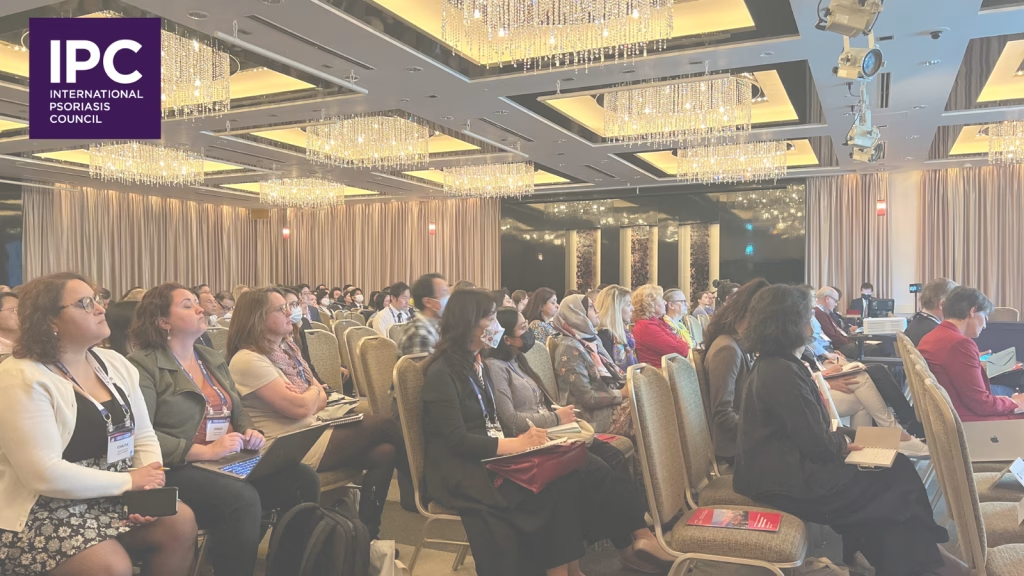
The 2023 International Societies for Investigative Dermatology (ISID) Meeting was held Wednesday, May 10- Saturday, May 2023, in Tokyo, Japan. The ISID Meeting is one of the largest global dermatology meetings with a focus on investigative dermatology and cutaneous biology, happening every five years and featuring cutting-edge data and emergent areas of science in dermatology and skin biology.
This year it was co-organized by the European Society for Dermatological Research (ESDR), the Japanese Society for Investigative Dermatology (JSID), the Society for Investigative Dermatology (SID) along with the Korean Society for Investigative Dermatology, the Taiwanese Society for Investigative Dermatology and the Australasian Society for Dermatology Research. The program featured keynote lectures by world-leading researchers, a series of plenary and concurrent thematic symposia, and submissions by researchers worldwide.
The sessions covered various topics, from Clinical Research, Epidemiology, Artificial Intelligence, and Translational Studies to Pharmacology and Drug Development. The following report includes 12 summaries of talks focusing on psoriasis, including IPC’s symposium “Disease Memory and Disease Modification in Psoriasis.” You can download the full report or read on for a summary.
IPC SYMPOSIUM – DISEASE MEMORY AND DISEASE MODIFICATION IN PSORIASIS
- Rachael Clark presented Tissue Resident Memory Cells. She discussed data about the role of resident memory T cells (TRM) in the course of psoriasis, but also about the niche that supports memory T cells and how an AhR agonist could reduce inflammation.
- Liv Eidsmo presented Epigenetic Inflammatory Memory and reviewed the most recent data about the epigenetic effect on psoriasis plaques as well as the role of epigenetic changes in stroma cells and their influence on the functionality of resident T cells in resolved psoriasis.
- Curdin Conrad, IPC Councilor, discussed Disease Modification, which reviewed anti-IL17s and anti–IL23s clinical data on treatment longevity. Moreover, he shared data about the sustained response with anti-IL23s upon withdrawal and suggested potential contributing factors. Finally, he briefed us about the role of T cell activation and resulting memory, the concept of depletion of skin resident memory T cells, and early intervention.
- Nicole Ward, IPC Councilor, gave an overview of the Future Directions in Psoriasis Research, including the biologic revolution, spatial sequencing, and machine learning to study inflammation, personalized medicine, and the use of biomarkers and the future of animal models.
A FRAMEWORK TO STUDY THE EPIDEMIOLOGICAL AND MOLECULAR BASIS OF PSORIASIS SEVERITY, WITH APPLICATION IN UK BIOBANK AND BSTOP
This lecture focused on identifying prognostic factors in psoriasis that would enable earlier intervention, reduction in the impact on quality of life, and potential limit of disease progression. Epidemiological factors are associated with psoriasis severity, including obesity and smoking. The HLA-C*06:02 allele was not positively associated with psoriasis severity, but a psoriasis PRS excluding this locus was associated.
THE RISK OF LYMPHOPROLIFERATIVE DISORDERS AND SKIN CANCERS IN PATIENTS WITH PSORIASIS AND INFLAMMATORY BOWEL DISEASE ADMINISTERED BIOLOGICS
Dr. Choi spoke on the potential effect of biologic agents on the risks of lymphoproliferative disorders and skin cancers in patients with psoriasis and shared her data from a Korean cohort.
A POPULATION-BASED COHORT STUDY OF SODIUM CONSUMPTION AND PSORIASIS
Dr. Chattopadhyay presented the effect of sodium consumption and the increased odds of psoriasis, especially in females. Additionally, the researchers found that sodium intake may partially but not fully explain the previously established association between psoriasis and hypertension.
DIFFERENT ASSOCIATIONS OF PSORIASIS SUBTYPES WITH AUTOIMMUNE DISORDERS IN UNITED STATES CHILDREN AND ADULTS: A CROSS-SECTIONAL STUDY
Dr. Ren presented the association of different psoriasis subtypes with autoimmune diseases, such as Crohn’s disease, Sjogren’s syndrome, vasculitis, and systemic lupus erythematosus, after using a machine learning model.
ADIPONECTIN AND SKIN DISEASES
Prof. Jin-Ho Chung reviewed the association of adiponectin with skin diseases, including psoriasis, and how treating adiponectin deficiency, present in psoriasis, with a novel adiponectin receptor agonist, APN5 (P5) could help in the management of the disease.
A NOVEL ASSESSMENT OF CARDIOVASCULAR HEALTH IN PEOPLE WITH PSORIASIS IN THE US: A CROSS-SECTIONAL STUDY
Dr. Wang’s presentation focused on the cardiovascular health of patients with psoriasis and the role of obesity and hypertension in that direction.
FIRST-IN-CLASS ORAL PEPTIDE SYSTEMICALLY TARGETING THE IL-23 PATHWAY
An oral therapeutic peptide, JNJ-77242113, targeting IL-23R that selectively blocks Il-23 signaling was presented, with encouraging phase I study results on psoriasis and phase 2 studies following.
EVIDENCE OF CAUSAL RELATIONSHIP BETWEEN STROKE AND PSORIASIS
Dr. Ramessur presented the strong causal effect of stroke on psoriasis risk and, on the reverse side, the weak causal effects of psoriasis on CAD and stroke.
For a more in-depth read, please download the full report.

Comments are closed.