

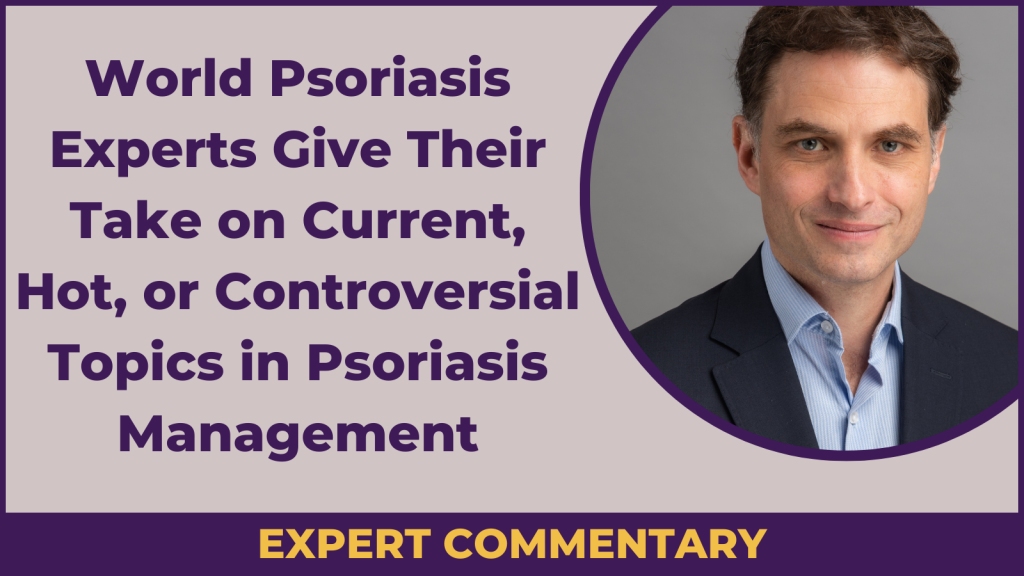
- Matías Maskin, MD
- Commentaries, Drug Approvals, Publications, Research, Treatment

PUBLICATIONS
Mental Health Outcomes in Patients with Moderate to Severe Psoriasis Treated with Bimekizumab: Analysis of Phase 2/3 Randomized Trials. Blauvelt A, Armstrong A, Merola JF, et al. J Am Acad Dermatol. 2024 Jul;91(1):72-81. doi: 10.1016/j.jaad.2024.02.039. Epub 2024 Mar 4. PMID: 38447700.
Why This Article Was Chosen
Patients with psoriasis have an increased prevalence of mental health disorders, including depression and suicidal ideation and behavior (SIB). Biologic treatments that target interleukin (IL)-17A (i.e., secukinumab and ixekizumab) have shown no increased risk of SIB.
The Food and Drug Administration (FDA) in the United States and the European Medicines Agency recently approved bimekizumab, an immunoglobulin G1 antibody that blocks IL-17 A/F, for treating patients with moderate to severe plaque psoriasis. In contrast to brodalumab, bimekizumab decreases circulating levels of IL-17A and IL-17F. The FDA label approved for brodalumab has a boxed SIB warning, and a Risk Evaluation and Mitigation Strategy program is required. Before brodalumab trials, studies did not closely monitor SIB. However, to better understand the effects of IL-17 inhibitors and other drugs intended for psoriasis treatment on mental health disorders, clinical trials with this focus have been implemented.
With multiple IL-17-targeting biologics currently available—with three distinct mechanisms of action: IL17A, IL-17RA, and IL-17A/F inhibition—it is essential to understand specific differences in the efficacy and safety profiles within the class of IL-17-inhibiting drugs.
This publication by Blauvelt et al. reports SIB and depression in patients with moderate to severe psoriasis treated in bimekizumab clinical trials across nine global phase 2/3 trials.
Commentary
This study evaluated adverse events from 2480 patients who received at least one bimekizumab dose across 9 phase 2/3 trials, including Phase 2 trials: BE ABLE 1 (NCT02905006); its extension study BE ABLE 2 (NCT03010527); PS0016 (NCT03025542); and its open-label extension (OLE) PS0018 (NCT03230292). Phase 3 trials: BE VIVID (NCT03370133); BE READY (NCT03410992); BE SURE (NCT03412747); their ongoing OLE, BE BRIGHT (NCT03598790); and BE RADIANT (including OLE; NCT03536884).
Treatment-emergent adverse events (TEAEs) were defined as adverse events that occurred during exposure to treatment, including 140 days (5 half-lives of bimekizumab) after receiving the last dose. An independent Neuropsychiatric Adjudication Committee evaluated potential neuropsychiatric treatment-related adverse events (TEAE) to determine whether TEAEs and abnormal electronic Columbia-Suicide Severity Rating Scale (eC-SSRS) and PHQ-9 scores met the criteria for suicidal ideation behavior (SIB). TEAEs adjudicated as SIB (including adjudicated suicidal ideation and adjudicated suicidal behavior [suicide attempt and completed suicide]) and TEAEs coded to the Medical Dictionary for Regulatory Activities v19.0 high-level term ‘‘depressive disorders’’, were pooled from all 9 phase 2/3 trials, including data from up to 5 years of bimekizumab exposure.
Previous or ongoing psychiatric disorders at baseline were reported by 14.4% of patients, with 6.9% reporting depressive disorders, 0.3% and 0.2% reporting previous self-injurious behavior and suicide attempts, respectively.
Adjudicated SIB and depression TEAEs Over 7166 patient-years (PY) of bimekizumab exposure, the exposure-adjusted incidence rates (EAIRs) of adjudicated SIB, suicidal ideation, and suicidal behavior were 0.13/100 PY, 0.08/100 PY, and 0.06/100 PY, respectively, and the EAIR of depressive disorders TEAEs was 0.5/100 PY. Adjudicated SIB rates with bimekizumab were in the range reported for anti-IL-17A antibody and anti-IL-23 therapies (0.09 to 0.19/100 PY) and lower than the rate reported for brodalumab (0.49/100 PY).
Across the included trials, one patient committed suicide (EAIR: 0.01/100 PY) during the BE BRIGHT OLE and three patients attempted suicide (EAIR: 0.04/100 PY); these patients had significant neuropsychiatric history (depression requiring inpatient treatment, two patients with previous suicide attempts), family history of suicide, or psychosocial stressors. For patients treated with bimekizumab, overall and new-onset positive eC-SSRS responses were low and generally similar to those receiving placebo and active comparators.
Across the pooled placebo-controlled periods of BE VIVID/BE READY, there were only nine new-onset positive responses and 1 in placebo patient. All nine positive responses in bimekizumab patients were to question 1, indicating passive suicidal ideation (no active ideation or behavior [attempted or completed suicides]). At baseline and through placebo- and comparator-controlled periods, mean PHQ-9 scores with bimekizumab were low, numerically lower than placebo, and similar to those with active comparators.
Positive responses to eC-SSRS question 1 and PHQ-9 question 9 were low throughout placebo and comparator-controlled periods, and rates were similar between bimekizumab and active comparators.
Adjudicated SIB rate in patients treated with bimekizumab was in the same range as patients in the general psoriasis population and those receiving IL-17A and IL-23 inhibitors, notwithstanding the more rigorous monitoring of SIB and proactive adjudication by the Neuropsychiatric Adjudication Committee in the bimekizumab trials. The SIB rate was lower with bimekizumab than with brodalumab. The SIB rate for bimekizumab falls within the range reported for these IL-17A inhibitors (0.09 to 0.14/100 PY), which do not have SIB warnings within their prescribing information. Interestingly, even though bimekizumab carries a warning for SIB, its mechanism of action is more similar to that of IL-17A antagonists secukinumab and ixekizumab, which lower serum IL-17A concentrations by directly binding IL-17 isomers.
As psoriasis treatment targets have evolved in recent years towards a clear/almost clear skin response, there is still a need for high-efficacy drugs. Though brodalumab carries a black box warning for SIB, the brodalumab trials did not prevent the enrollment of patients with a high risk for SIB, which may have contributed to the higher SIB detection in those studies. In addition, a causal relationship has not been revealed for SIB in brodalumab clinical trials, and a recently published pharmacovigilance US report over five years has found no new safety signals. This article by Blauvelt et al. adds vital information on bimekizumab data to better understand its safety profile, especially related to SIB and depression.



Comments are closed.