- Maria-Angeliki Gkini, MD, MSc, PhD, FRCP and Josep Riera, MD
- Congress Reports, Comorbidities, Patient Care Resources, Pediatrics, Quality of Life, Research, Treatment
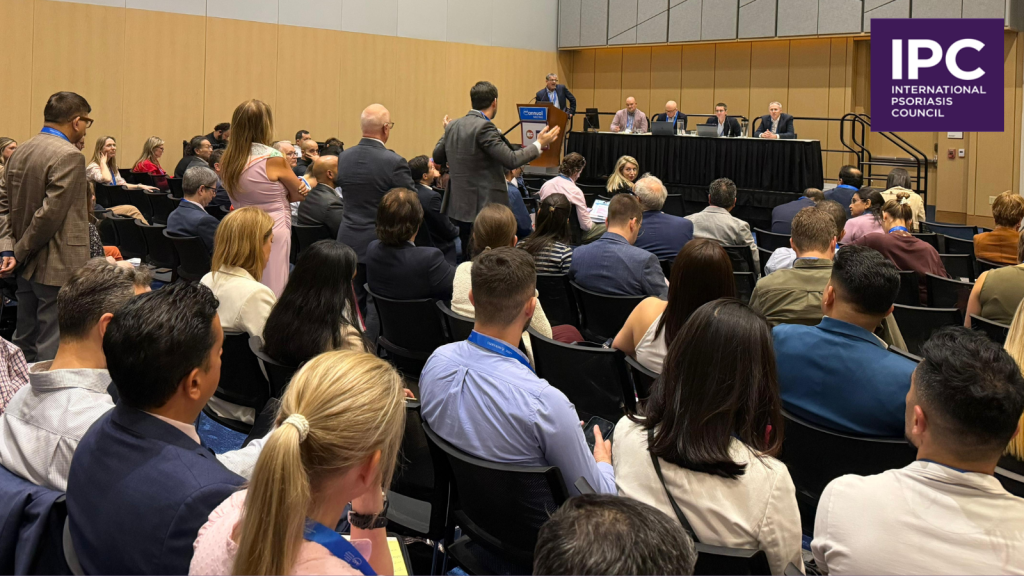
The 2026 American Academy of Dermatology (AAD) Annual Meeting took place in Denver, Colorado, United States, from Thursday, March 26, to Tuesday, March 31, 2026. This annual meeting brought together more than 20,000 attendees, including leading dermatology experts, researchers, and clinicians, and featured over 275 sessions highlighting late-breaking research, emerging therapies, and evolving clinical challenges. This blog post overviews key psoriasis sessions, including the IEC & IPC Joint Symposium and selected late-breaking research. Download the full 2026 AAD Congress Report for a comprehensive review or continue reading for session highlights.
IEC & IPC JOINT SYMPOSIUM: PSORIASIS OR DERMATITIS? WHEN BOUNDARIES BLUR AND TREATMENTS FLIP THE SCRIPT
Diagnostic Challenges Between Atopic Dermatitis and Psoriasis
Andrew Pink, PhD, IPC Councilor
Professor Andrew Pink reviewed diagnostic challenges between atopic dermatitis (AD) and psoriasis, including mixed-phenotype presentations and overlapping immune pathways (Th1/Th17 vs Th2). He described presentations involving separate anatomical sites, fluctuating disease within the same site, and overlapping phenotypes such as sebopsoriasis and psoriasiform eczema. Diagnostic evaluation includes clinical history, investigations, and treatment response, with genetic data demonstrating both shared and distinct disease mechanisms.
Eczematous Reactions in Patients Receiving Treatments for Psoriasis: Clinical Presentation
Jason Hawkes, MD, MS, FAAD, IPC Councilor
Dr. Jason Hawkes reviewed eczematous reactions in patients receiving biologic therapies for psoriasis, including clinical presentation, terminology, and diagnostic challenges. He emphasized the difficulty in distinguishing paradoxical reactions from misdiagnosis, given overlapping features and the absence of definitive biomarkers. Observational data showed remission after switching to an interleukin-23 inhibitor in reported cases.
Eczematous Reactions in Patients Receiving Treatments for Psoriasis: Clinical Approach
Kenneth Gordon, MD, IPC Councilor
Dr. Kenneth Gordon outlined a clinical approach to managing eczematous reactions in patients receiving biologic therapy, including diagnostic evaluation and treatment decision-making. He described proposed mechanisms such as immune deviation and involvement of multiple inflammatory pathways, although these are not definitively established. Management strategies include continuing therapy with adjunctive treatment, switching biologics, or discontinuation based on clinical response.
Psoriasiform Reactions in Patients Receiving Treatments for Atopic Dermatitis & Prurigo Nodularis: Clinical Presentation
Shawn G. Kwatra, MD
Dr. Shawn G. Kwatra presented on psoriasiform reactions associated with therapies for atopic dermatitis and prurigo nodularis, including incidence, clinical features, and time to onset. Plaque psoriasis was the most common presentation, with involvement frequently affecting the extremities. These reactions reflect a shift from Th2-driven inflammation toward Th1/Th17 pathways and have been reported more frequently in patients with a personal or family history of psoriasis.
Psoriasiform Reactions in Patients Receiving Treatments for Atopic Dermatitis & Prurigo Nodularis: Clinical Approach
Yael Anne Leshem, MD, MCR
Dr. Yael Anne Leshem reviewed the pathogenesis and management of psoriasiform reactions in atopic dermatitis, including the “flip-flop” phenomenon between AD and psoriasis phenotypes. She outlined treatment strategies including topical therapy, systemic immunomodulation, biologic modification, and targeting of alternative immune pathways. Reported switching rates are low, and management should be individualized based on clinical response.
What is Psoriasiform Spongiotic Dermatitis? Navigating Uncertainty Using Advanced Diagnostics
Kilian Eyerich, MD, PhD, IPC Councilor
Professor Kilian Eyerich discussed the use of molecular diagnostics and immune profiling in inflammatory skin diseases. He described a shift from morphology-based classification to immune pathway–based frameworks, including Th1, Th2, and Th17 patterns. Matching dominant immune expression profiles to targeted therapies may improve response rates, though overlapping phenotypes remain common.
Anti-TNF-α Induced Skin Eruptions in Patients with Inflammatory Bowel Disease: Presentation and Clinical Approach in Adults
Lev Pavlovsky, MD, PhD, IPC Councilor
Dr. Lev Pavlovsky reviewed anti-TNF–induced psoriasiform eruptions in patients with inflammatory bowel disease, including incidence, risk factors, and clinical presentation. Many patients have no prior history of psoriasis, with lesions commonly involving the scalp, trunk, and extremities. Management depends on severity and may include continuing therapy, discontinuing therapy, or modifying therapy.
Anti-TNF-α Induced Skin Eruptions in Patients with Inflammatory Bowel Disease: Presentation and Clinical Approach in Children
Amy Paller, MS, MD, IPC Board Member
Dr. Amy Paller discussed pediatric TNF inhibitor–induced psoriasiform dermatitis, including prevalence ranges, clinical features, and diagnostic challenges. Presentations often involve multiple sites, with the scalp most commonly affected, and may overlap with psoriasis or atopic dermatitis. Management frequently requires discontinuation of TNF inhibitors and selection of alternative therapies.
Mechanistic Aspects of Paradoxical Reactions and Iatrogenic Switches
Johann Gudjonsson, MD, PhD, IPC Board Member
Professor Johann Gudjonsson discussed the immunologic mechanisms underlying paradoxical reactions and iatrogenic switches. He described how targeted cytokine blockade may lead to compensatory activation of alternative immune pathways. These reactions reflect immune network plasticity and align with dominant immune patterns such as Th1, Th2, and Th17.
OTHER PSORIASIS SESSIONS
Therapeutic Hotline: What’s New this Year in Psoriasis Biologics
Joseph Merola, MD, MMSc, IPC Councilor
Dr. Joseph Merola reviewed advances in psoriasis and psoriatic arthritis therapeutics, with a focus on interleukin-23 pathway agents, oral TYK2 inhibitors, and emerging long-acting biologics. He presented data on icotrokinra demonstrating strong efficacy across PASI and quality-of-life endpoints with durable responses through 52 weeks. Combination therapy with ixekizumab and tirzepatide showed improved skin clearance and weight loss outcomes compared to monotherapy, highlighting the potential for multimodal treatment approaches.
Psoriasis: Modern Therapeutic Approaches
Bruce Strober, MD, PhD, IPC President; Richard Langley, MD, IPC Councilor; Mona Shahriari, MD; Jeffrey Cohen, MD, MPH, IPC Councilor; Jennifer Soung, MD; Joel Gelfand, MD, MSCE, IPC Board Member; Kenneth Gordon, MD, IPC Councilor
Presenters reviewed current approaches to psoriasis management, including emerging therapies, early treatment decisions, and key comorbidities. They emphasized expanding treatment considerations beyond traditional severity measures to include patient burden, high-impact disease sites, and risk of disease progression. The session also reinforced psoriasis as a systemic disease, with a focus on coordinated care and comorbidity screening.
What is Safe to Use for Routine Dermatologic Disease if Your Patient Has Been Diagnosed with Cancer? Managing Psoriasis and Atopic Dermatitis in Patients with Cancer
Gowri Kabbur, MD
Dr. Gowri Kabbur discussed the management of psoriasis and atopic dermatitis in patients with current or prior malignancy, using a case-based approach. She emphasized prioritizing non-immunosuppressive therapies, including topical agents, phototherapy, and acitretin, with systemic options considered based on safety data. Treatment decisions should balance disease control with malignancy risk and be made in coordination with oncology.
What is Safe to Use for Routine Dermatologic Disease if Your Patient Has Been Diagnosed with Cancer? Treatment of Hand and Foot Psoriasis
Bruce Strober, MD, PhD, IPC President
Dr. Bruce Strober reviewed the diagnosis and management of palmoplantar psoriasis and palmoplantar pustulosis, emphasizing the importance of accurate diagnosis. He discussed common triggers, including smoking and biologics, and noted variability in treatment response across patients. Treatment approaches include biologics, JAK inhibitors, and traditional systemic therapies, with management guided by disease severity and impact on quality of life.
LATE BREAKING NEWS
Envudeucitinib (ESK-001) in Moderate to Severe Plaque Psoriasis: 24-Week Results from the Randomized, Double-Blind, Active Comparator- and Placebo-Controlled, Phase 3 ONWARD 1 and 2 Studies
Andrew Blauvelt, MD, MBA, IPC Board Member
Dr. Andrew Blauvelt presented 24-week phase 3 results for envudeucitinib, demonstrating high PASI 75 and PASI 90 response rates with continued improvement over time. Separation from placebo was observed as early as week 4, with additional improvements in itch and quality-of-life measures. The safety profile was favorable, with low rates of serious adverse events and no major safety signals reported.
Once-Daily Oral Zasocitinib Demonstrates Rapid and Reproducible Skin Clearance with a Consistent Safety Profile in Moderate to Severe Plaque Psoriasis: Results from Two Randomized Phase 3 Trials (LATITUDE-PsO-3001 and 3002)
Melinda Gooderham, MD, IPC Councilor
Dr. Melinda Gooderham presented phase 3 results for zasocitinib, showing high PASI 75 and PASI 90 response rates and sustained efficacy through follow-up. Improvements in skin clearance and quality-of-life measures were observed as early as week 4. Safety findings were consistent across studies, with mostly mild to moderate adverse events and ongoing long-term evaluation.
We encourage you to download the full 2026 AAD Congress Report for comprehensive coverage of psoriasis-focused sessions, detailed summaries, and complete findings.