
Video
Complementary Strategies in Psoriasis.
IPC Councilor Dr. Fernando Valenzuela reviews non-pharmacological strategies for managing psoriasis, covering diet,…
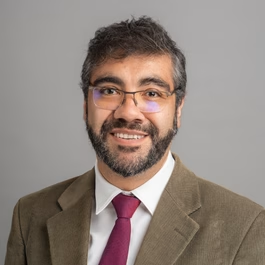
IPC Councilor Dr. Fernando Valenzuela reviews non-pharmacological strategies for managing psoriasis, covering diet,…
Watch VideoEl Dr. Fernando Valenzuela, Consejero de IPC, repasa las estrategias no farmacológicas para el manejo de la psoriasis,…
Watch VideoKey takeaways from the 2025 EADV Congress in Paris, including the IPC Symposium on psoriasis, Free Communication…
View ReportIPC Councilor Dr. Fernando Valenzuela explains how phototherapy can be effectively used to treat psoriasis in pediatric…
Watch VideoEn este video de Take Ten con IPC, el Dr. Fernando Valenzuela analiza la conexión entre la salud oral y la psoriasis,…
Watch VideoIn this Take Ten with IPC video, Dr. Fernando Valenzuela explores the connection between oral health and psoriasis,…
Watch VideoEl Dr. Fernando Valenzuela analiza las ventajas y desventajas de la fototerapia como opción de tratamiento para…
Watch VideoREUNIÓN ANUAL DE DERMATÓLOGOS LATINOAMERICANOS (RADLA) | LIMA, PERÚ Tuesday, May 7 09:00– 12:00 PET Program…
IPC stands for accessible treatment and universal healthcare on World Psoriasis Day and beyond. Gain insights from…
Read MoreDr. Fernando Valenzuela discusses how he treats nail psoriasis in his daily practice. El Dr. Fernando Valenzuela…
Watch VideoThe IPC’s global network of experts generously volunteers their time every year to educate and train other physicians…
Read MoreREUNIÓN ANUAL DE DERMATÓLOGOS LATINOAMERICANOS (RADLA) | CURITIBA, BRAZIL Friday, May 26 14:00 – 17:00 BRT 13:00…
La XXXIX Reunión Anual de Dermatólogos Latinoamericanos (RADLA) se realizó de manera virtual del 2 al 5 de mayo,…
Read MoreIt is not fully understood the impact that COVID-19 has on psoriasis patients. .
Read MoreBiologics and biosimilars have created many new options in psoriasis treatment for patients worldwide, but patients…
Read MoreView Report
Latin American countries view biosimilar agents as an effective approach to curtail health-care expenditures while…
View Report| Cookie | Duration | Description |
|---|---|---|
| cookielawinfo-checkbox-analytics | 11 months | This cookie is set by GDPR Cookie Consent plugin. The cookie is used to store the user consent for the cookies in the category "Analytics". |
| cookielawinfo-checkbox-functional | 11 months | The cookie is set by GDPR cookie consent to record the user consent for the cookies in the category "Functional". |
| cookielawinfo-checkbox-necessary | 11 months | This cookie is set by GDPR Cookie Consent plugin. The cookies is used to store the user consent for the cookies in the category "Necessary". |
| cookielawinfo-checkbox-others | 11 months | This cookie is set by GDPR Cookie Consent plugin. The cookie is used to store the user consent for the cookies in the category "Other. |
| cookielawinfo-checkbox-performance | 11 months | This cookie is set by GDPR Cookie Consent plugin. The cookie is used to store the user consent for the cookies in the category "Performance". |
| viewed_cookie_policy | 11 months | The cookie is set by the GDPR Cookie Consent plugin and is used to store whether or not user has consented to the use of cookies. It does not store any personal data. |
IPC Jr. Councilor Towhida Noor reviews the psoriasis pipeline: selective TYK2 inhibitors, long-acting IL-17 and IL-23 biologics, and IL-36 blockade in GPP.
IPC Board Member and Treasurer Joel Gelfand, MD, MSCE, is the editor of a new textbook, Psoriasis: An Expert Global Perspective, now available for preorder from Elsevier. He worked with associate editors IPC President Bruce Strober, MD, PhD; IPC Vice President/President-Elect Claudia de la Cruz, MD; and IPC Chief Medical Officer Peter van de Kerkhof, MD, PhD. Nearly 50 authors from 20 countries contributed 30 chapters covering psoriasis from its earliest descriptions through genetics, immunology, and current therapies, with clinical images of psoriasis across diverse skin tones. All royalties support IPC.
PRE-ORDER YOUR COPY
In this video, IPC Councilor Rodrigo Garcia Salinas, MD, a rheumatologist from Argentina, explains how to recognize psoriatic arthritis early, including why joint pain, how long a patient has had psoriasis, and family history can matter more than skin severity alone. He also reviews how imaging helps catch early disease and how to choose treatment based on each patient’s joint, spine, and skin involvement.
IPC President Bruce Strober reviews the link between psoriasis and metabolic disease, drawing on findings from IPC’s recent paper in the Journal of the American Academy of Dermatology (JAAD). He translates this growing body of evidence into five concrete priorities from the 2025 IPC Think Tank for improving cardiometabolic screening and care.