
Video
Why Treatment Fails: Interferons, Immune Rewiring, and Biological Escape Mechanisms.
Professor Curdin Conrad discusses why psoriasis treatments may fail, drawing on immunological mechanisms and relevant…
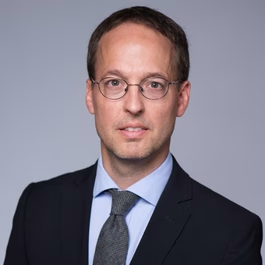
Professor Curdin Conrad discusses why psoriasis treatments may fail, drawing on immunological mechanisms and relevant…
Watch VideoIPC summarizes presentations from its symposium at the 2026 SID Annual Meeting, including disease interception,…
View ReportIPC Councilor Curdin Conrad reviews conventional oral systemic therapies, including their proper use and recent…
Watch VideoThe 2025 ESDR Congress in Antwerp brought together over 1,000 dermatology researchers. This report summarizes the…
View ReportProfessor Curdin Conrad discusses trained immunity and epigenetic memory in inflammatory diseases, highlighting…
Watch VideoThe 2024 IPC Think Tank Congress Report provides a comprehensive summary of key topics, including the epidemiology of…
Read MoreThe program chair and faculty address questions from IPC Global Webinar 3: "The Full Cycle of Psoriasis Care in 2024:…
Watch VideoDr. Curdin Conrad explores guttate psoriasis and discusses various treatment options and therapies designed to target…
Watch VideoIPC GLOBAL WEBINAR SERIES Program chairs: Curdin Conrad, Switzerland Program faculty: Cristina Echeverría, Argentina…
The 2024 Society for Investigative Dermatology (SID) Annual Meeting was held from May 14 to 18, 2024, in Dallas, Texas,…
Read MoreDr. Curdin Conrad offers insights into the latest advances in psoriasis treatment, highlighting the factors that…
Watch VideoSOCIETY FOR INVESTIGATIVE DERMATOLOGY (SID) | DALLAS, TEXAS Wednesday, May 15 9:00 - 12:00 CDT Program chairs:…
Access the latest insights from the 32nd European Academy of Dermatology and Venereology 2023 Congress (EADV) in…
Read MoreDr. Conrad discusses whether we can now modify the course of the disease or at least prevent the need for ongoing…
Watch VideoThe International Society of Investigative Dermatology (ISID) held its inaugural meeting in Tokyo, Japan, from May 10…
Read MoreThe European Academy of Dermatology and Venereology (EADV) organized its 31st congress in Milano, Italy, under the…
Read MoreINTERNATIONAL SOCIETIES FOR INVESTIGATIVE DERMATOLOGY MEETING (ISID) | TOKYO, JAPAN Wednesday, May 10 11:30 - 15:00…
The Psoriasis: from Gene to Clinic International Congress provides a forum for psoriasis experts from around the world…
Read More| Cookie | Duration | Description |
|---|---|---|
| cookielawinfo-checkbox-analytics | 11 months | This cookie is set by GDPR Cookie Consent plugin. The cookie is used to store the user consent for the cookies in the category "Analytics". |
| cookielawinfo-checkbox-functional | 11 months | The cookie is set by GDPR cookie consent to record the user consent for the cookies in the category "Functional". |
| cookielawinfo-checkbox-necessary | 11 months | This cookie is set by GDPR Cookie Consent plugin. The cookies is used to store the user consent for the cookies in the category "Necessary". |
| cookielawinfo-checkbox-others | 11 months | This cookie is set by GDPR Cookie Consent plugin. The cookie is used to store the user consent for the cookies in the category "Other. |
| cookielawinfo-checkbox-performance | 11 months | This cookie is set by GDPR Cookie Consent plugin. The cookie is used to store the user consent for the cookies in the category "Performance". |
| viewed_cookie_policy | 11 months | The cookie is set by the GDPR Cookie Consent plugin and is used to store whether or not user has consented to the use of cookies. It does not store any personal data. |
IPC Jr. Councilor Towhida Noor reviews the psoriasis pipeline: selective TYK2 inhibitors, long-acting IL-17 and IL-23 biologics, and IL-36 blockade in GPP.
IPC Board Member and Treasurer Joel Gelfand, MD, MSCE, is the editor of a new textbook, Psoriasis: An Expert Global Perspective, now available for preorder from Elsevier. He worked with associate editors IPC President Bruce Strober, MD, PhD; IPC Vice President/President-Elect Claudia de la Cruz, MD; and IPC Chief Medical Officer Peter van de Kerkhof, MD, PhD. Nearly 50 authors from 20 countries contributed 30 chapters covering psoriasis from its earliest descriptions through genetics, immunology, and current therapies, with clinical images of psoriasis across diverse skin tones. All royalties support IPC.
PRE-ORDER YOUR COPY
In this video, IPC Councilor Rodrigo Garcia Salinas, MD, a rheumatologist from Argentina, explains how to recognize psoriatic arthritis early, including why joint pain, how long a patient has had psoriasis, and family history can matter more than skin severity alone. He also reviews how imaging helps catch early disease and how to choose treatment based on each patient’s joint, spine, and skin involvement.
IPC President Bruce Strober reviews the link between psoriasis and metabolic disease, drawing on findings from IPC’s recent paper in the Journal of the American Academy of Dermatology (JAAD). He translates this growing body of evidence into five concrete priorities from the 2025 IPC Think Tank for improving cardiometabolic screening and care.