- HELEN YOUNG
- Comorbidities, Expert Insights, Treatment
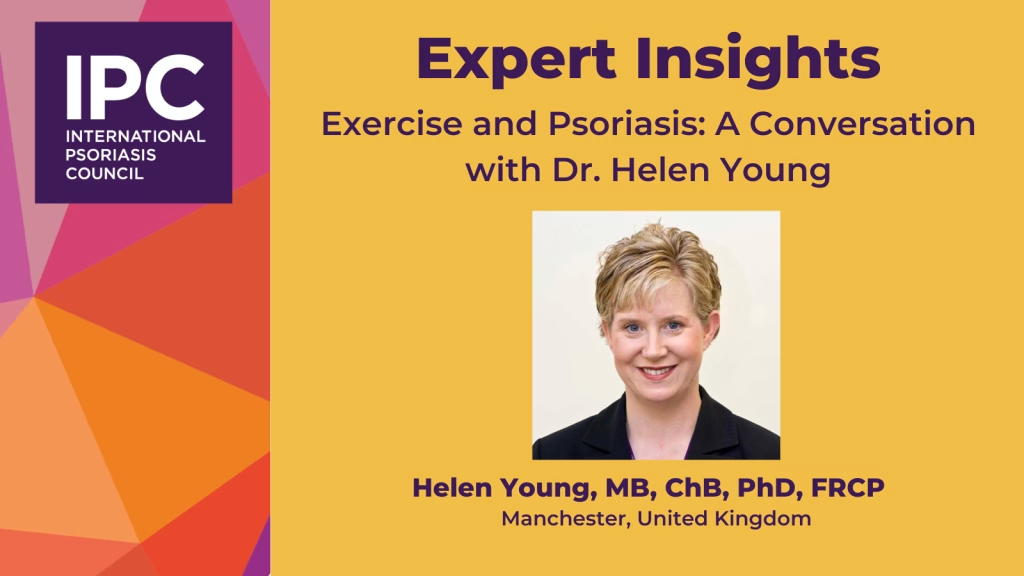
Helen Young, MB, ChB, PhD, FRCP
The University of Manchester
Manchester, United Kingdom
DEFINITIONS
- Pulse wave velocity (PWV) measures arterial stiffness as a preclinical indicator of
future risk of cardiovascular disease. Aerobic activity can lead to a significant
improvement in PWV. It has been suggested that there may be an independent
association between moderate to severe chronic plaque psoriasis and increased
arterial stiffness. - Diastolic reflection area (DRA) is a variable that reflects left ventricular function.
Higher DRA is associated with better coronary perfusion. People who exercise
are known to have higher DRA. - International Physical Activity Questionnaire (IPAQ) is a self-reported
questionnaire developed as a tool for measuring physical activity and inactivity.
BACKGROUND
- Patients with psoriasis have an increased risk for cardiovascular disease (CVD).
Several risk factors for CVD —including hypertension, obesity, and insulin
resistance —are prevalent among patients with psoriasis. - The disease often limits the physical activity level in patients with psoriasis, and
lack of physical activity may increase CVD risk. - Psychosocial distress and fear of being stigmatized often lead patients to avoid
situations where others may comment negatively on their appearance. These
situations may include activities like sports or exercising at a gym, which may
subsequently lead to lower physical activity levels. - Some patients also avoid physical activity because traditional exercise attire is often too tight and irritates the skin.
RECENT RESEARCH
Auker L, Cordingley L, Griffiths C, Young H. Physical Activity is Important for Cardiovascular
Health and Cardiorespiratory Fitness in Patients with Psoriasis. Clin Exp Dermatol. 2022; 47:
289-296. https://doi.org/10.1111/ced.14872.
Auker L, Cordingley L, Pye S, Griffiths C, Young H, What are the Barriers to Physical Activity in
Patients with Chronic Plaque Psoriasis? Br J Dermatol. 2020; 183: 1094-1102.
https://doi.org/10.1111/bjd.18979.
Docherty S, Harley R, McAuley J, et al. The Effect of Exercise on Cytokines: Implications for
Musculoskeletal Health: A Narrative Review. BMC Sports Sci Med Rehabil. 2022; 14, 5.
https://doi.org/10.1186/s13102-022-00397-2.
Thomsen RS, Nilsen TIL, Haugeberg G, Bye A, Kavanaugh A, Hoff M. Impact of High-Intensity
Interval Training on Disease Activity and Disease in Patients with Psoriatic Arthritis: A
Randomized Controlled Trial. Arthritis Care Res (Hoboken). 2019; 71(4):530-537. doi:
10.1002/acr.23614. PMID: 29882634.
Zheng Q, Sun XY, Miao X, et al. Association Between Physical Activity and Risk of Prevalent
Psoriasis: A MOOSE-compliant Meta-analysis. Medicine. 2018; 97(27):e11394. doi:
10.1097/MD.0000000000011394. PMID: 29979432; PMCID: PMC6076093.
Patients with psoriasis are at increased risk for cardiovascular disease —and lack of physical
activity may be a driving cause.
“People with psoriasis are significantly prevented from undertaking health-promoting levels of
exercise due to a number of psoriasis-specific barriers. Severity, skin sensitivity, clothing,
treatments, social concerns —all of these can play a role in how much someone with psoriasis
participates in physical activity.”
—Helen Young, MB, ChB, PhD, FRCP, IPC Councilor
IPC Councilor Helen Young, MB, ChB, PhD, FRCP, and her team have extensively studied the link
between physical activity and psoriasis. Here, we discuss several findings of her recent work in
Manchester, UK, and the aims of future research in this field.
Psoriasis-specific exercise recommendations
When it comes to people with psoriasis, it is still unclear if recommendations should be any different than they are for the general population. But work so far suggests that a tailored approach to increasing physical activity in the psoriasis population could help diminish cardiovascular (CVD) risk.
Dr. Young led the 2021 study, “Physical activity is important for cardiovascular health and
cardiorespiratory fitness in patients with psoriasis” [co-authors: L/ Auker, L. Cordingley, C.E.M.
Griffiths].
The study included 242 patients with chronic plaque psoriasis who were 18 or older and receiving treatment in North-West England. The researchers hypothesized that objective measurement of physical activity could improve outcomes.
At the time of the study, previous research had shown that aerobic exercise could provide significant improvements in arterial stiffness. However, the effect of physical activity on arterial
stiffness in people with psoriasis was unknown.
Dr. Young discusses the results of the study: “We discovered evidence of a clear, significant relationship between the volume of a person’s physical activity and their likelihood of developing CVD in the future, as measured by pulse wave velocity (PWV). Additionally, we found a significant relationship between exercise
intensity and the diastolic reflection area (DRA), suggesting that DRA could be a surrogate marker for cardiorespiratory fitness. DRA is an objective and non-invasive measurement of a patient’s exercise adherence, and that could be very helpful in the future when developing and evaluating exercise programs.”
The relationship between disease severity and physical activity
In 2020, Dr. Young led the study, “What are the barriers to physical activity in patients with chronic plaque psoriasis?” [co-authors: L. Auker, L. Cordingley, S.R. Pye, C.E.M. Griffiths].
It had previously been suggested that an individual psoriasis patient’s activity level depended on their disease severity. However, when Dr. Young’s team began their study, the actual objective evidence was limited.
The researchers recruited 404 patients ages 18 and older with chronic plaque psoriasis receiving treatment in North-West England. Each patient completed the short version of the International Physical Activity Questionnaire (IPAQ).
To classify disease severity, the researchers took a multipronged approach. They documented each participant’s clinical history and conducted a Psoriasis Area and Severity Index (PASI) assessment, but they didn’t stop there.
“Classifying severity isn’t always straightforward,” explains Dr. Young. “When we look at PASI, we’re looking at a patient’s current severity, a snapshot in time. But more historical factors, like disease duration, could also impact physical activity.” Accordingly, the researchers also included the history/interventions component of the Simplified Psoriasis Index (SPI-i) (modified to remove disease duration).
There was a small but significant negative correlation between both indices and levels of
physical activity.
The impact of quality of life on physical activity
Since psoriasis can take a significant toll on the psychosocial aspects of a patient’s life, it may
not be sufficient to look at disease severity solely through the lenses of PASI and SPI-i.
Recognizing the need to consider psychological barriers to exercise, Dr. Young and her team also asked participants in the above study (“What are the barriers to physical activity in patients with chronic plaque psoriasis?”) six of the Dermatology Life Quality Index (DLQI) questions that they identified as having the potential to impact physical activity:
- Question 1: “Over the last week, how itchy, sore, painful, or stinging has your skin
been?” - Question 2: “Over the last week, how embarrassed or self-conscious have you been
because of your skin?” - Question 4: “Over the last week, how much has your skin influenced the clothes you
wear?” - Question 5: “Over the last week, how much has your skin affected any social or leisure
activities?” - Question 6: “Over the last week, how much has your skin made it difficult for you to do
any sport?” - Question 10: “Over the last week, how much of a problem has the treatment for your
skin been, for example, by making your home messy or by taking up time?”
The results were similar to those observed when comparing physical activity with PASI and SPI-i.
As DLQI increased, the level of physical activity decreased.
In the pipeline: further exploration of the relationship between psoriasis and physical activity
Dr. Young’s team are currently conducting a research study with an exercise intervention
specifically designed for patients with psoriasis by those who have lived-experience with the
disease, in conjunction with sports scientists, and clinicians.
She describes, “Our ongoing work will define the benefit to skin, heart, and well-being health outcomes of exercise for patients with psoriasis. We are also hopeful that we will be able to quantify the volume of exercise required and that this may allow ‘dosing’ of exercise as an adjuvant to standard treatments in the future.”
The research team plans to report on their findings later this year. Dr. Young and her colleagues have provided invaluable contributions to research surrounding the link between psoriasis and physical activity. There is still a long way to go, especially regarding psoriasis-specific recommendations. As research continues, dermatologists must incorporate a focus on exercise into practice and work to help patients overcome barriers to get the physical activity they need.