- IPC GENERAL
- Disease Severity, IPC News, IPC Publications, Publications, Treatment, Treatment Guidelines
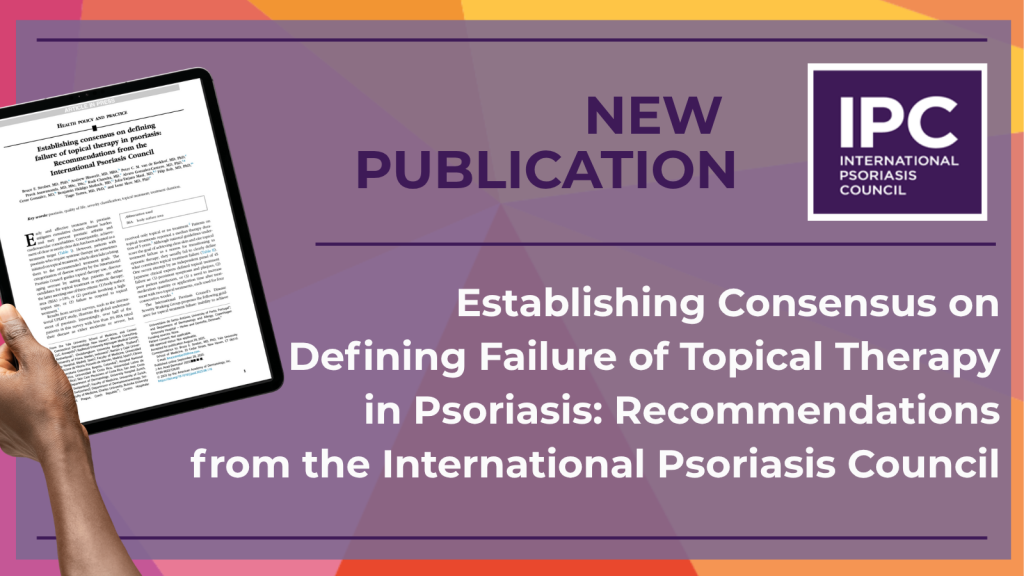
The International Psoriasis Council (IPC) has published a new article in the Journal of the American Academy of Dermatology (JAAD) titled Establishing Consensus on Defining Failure of Topical Therapy in Psoriasis: Recommendations from the International Psoriasis Council.
This publication examines one of the most debated questions in psoriasis management: When is topical therapy no longer sufficient, and when should a transition to systemic treatment be considered?
Led by IPC Board President Bruce Strober, with contributions from a global panel of IPC experts, this consensus statement provides the first internationally aligned framework to define failure of topical therapy in psoriasis, an essential component of IPC’s disease severity reclassification model.
The paper outlines the following key recommendations:
- Definition of Topical Therapy Failure: Inability to achieve clear or nearly clear skin (body surface area ≤1% or Physician’s Global Assessment 0–1) after two consecutive 4-week topical therapy courses.
- Clinical Considerations: A patient’s self-assessment should strongly influence treatment decisions, especially when they report moderate or severe disease despite a provider’s mild assessment.
- Transition to Systemic Therapy: Failure of appropriately used topical therapy should prompt consideration of ultraviolet phototherapy or systemic therapy, with topicals maintained as adjuvants for residual lesions.
- Guideline Variability: While national and regional guidelines recognize topical failure as a key indicator for escalation, they rarely define it clearly. The IPC’s recommendations aim to bridge this gap and support consistent, evidence-based treatment decisions worldwide.
- Individualized Care: Decisions should be tailored to each patient’s presentation, comorbidities, adherence, and access to therapies, aligning with regional recommendations.
These recommendations are essential to improving psoriasis management globally by clarifying when to escalate care and ensuring patients receive timely, effective treatment to prevent long-term disease burden and comorbidities.
This publication builds upon IPC’s ongoing efforts to enhance clinical decision-making through its Disease Severity Reclassification, encouraging dermatologists to assess psoriasis not only by surface area but by impact on patients’ daily lives.
Related Resources:
- Dermatology Times Feature: IPC Brings Clarity to Topical Therapy Failure
- Video: Establishing Consensus on Defining Failure of Topical Therapy in Psoriasis: Featuring IPC President Bruce Strober, MD, PhD
- Educational Slide Set: Understanding IPC’s Psoriasis Severity Reclassification in Clinical Practice: Available for clinicians who wish to present this topic in upcoming lectures.