
- Alison Treichel, MD, FAAD
- Congress Reports, Comorbidities, Disease Severity, Genetics, Pathophysiology, & Epidemiology, Treatment
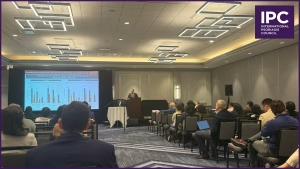
The 2025 International Psoriasis Council (IPC) Think Tank was held in San Juan, Puerto Rico, with both in-person and virtual participation, bringing together IPC Board Members, Councilors, Junior Councilors, Fellows, Corporate Members, and Partner Organizations for focused discussions on emerging priorities in psoriasis research and care. The meeting provided a forum for global experts to exchange perspectives and inform IPC’s ongoing scientific and educational work.
This congress report summarizes key presentations from the scientific symposium, Advancing Integrated Care: Psoriasis, Metabolic Health, and Future Therapeutics, with emphasis on the links between psoriasis and cardiometabolic disease, evolving biomarkers, and therapeutic approaches, including GLP-1 receptor agonists. Download the full 2025 IPC Think Tank Congress Report for complete details or read on for session summaries.
SCIENTIFIC SYMPOSIUM: ADVANCING INTEGRATED CARE: PSORIASIS, METABOLIC HEALTH, AND FUTURE THERAPEUTICS | SESSION 1: MECHANISTIC ASPECTS
Epidemiology of Metabolic Syndrome, Cardiovascular Disease, and Psoriasis
Joel Gelfand, MD, MSCE, IPC Board Member
Dr. Joel Gelfand reviewed the epidemiologic evidence positioning psoriasis as a systemic inflammatory disease with meaningful cardiometabolic consequences. Moderate to severe psoriasis is associated with increased risk of major adverse cardiovascular events, cardiovascular death, chronic kidney disease, and diabetes, with cardiovascular disease remaining a leading cause of mortality. He highlighted a dose-response relationship between psoriasis severity and cardiometabolic risk, including evidence that higher BSA and PASI correlate with increased diabetes and cardiovascular risk. Obesity was presented as both a driver of psoriasis incidence and severity and a modifier of treatment response, including reduced durability of biologic response. Despite growing awareness, cardiometabolic screening remains underutilized in dermatology settings, and the recognition of psoriasis as a cardiovascular risk factor remains limited in primary care, underscoring a persistent care gap.
Shared Genetic Loci Between Psoriasis and Metabolic Syndrome
Anne Bowcock, PhD, IPC Councilor
Dr. Anne Bowcock summarized genetic and Mendelian randomization data evaluating whether cardiometabolic traits are associated with, or causally related to, psoriasis risk. She reviewed population data linking obesity-related traits to psoriasis. She emphasized evidence that genetically proxied BMI has a causal effect on psoriasis risk, while reverse analyses do not support psoriasis genetic risk as a cause of higher BMI. She also described emerging work showing shared susceptibility genes between psoriasis and coronary artery disease, with genetic risk for coronary disease and stroke associated with increased psoriasis risk, and less evidence supporting the reverse direction. She concluded that integrating genetic risk profiles with clinical phenotyping may enable earlier identification of systemic risk and inform future prevention strategies.
Molecular Mechanisms of Psoriasis Immunometabolism: A Comprehensive Overview
Álvaro González-Cantero, MD, PhD, IPC Councilor
Dr. Álvaro González-Cantero framed psoriasis as an immunometabolic disease shaped by bidirectional signaling between immune pathways and cellular metabolism. He described how obesity and adipose inflammation amplify systemic cytokine signaling and insulin resistance, reinforcing inflammatory circuits relevant to psoriasis. Spatial and proteomic approaches were highlighted as tools that reveal layer-specific metabolic signatures in psoriatic skin, including the upregulation of lipid and cholesterol pathways in key compartments. He also reviewed emerging targets linked to metabolic programming in immune and stromal cells, noting that residual systemic inflammation and cardiometabolic risk can persist even when skin disease is controlled with biologics. Dietary quality was discussed as a potential modifier of inflammatory and metabolic pathways, raising the broader question of whether long-term disease modification will require addressing metabolic dysfunction directly.
Serum Adiponectin Levels and Their Association with Cardiometabolic Risk Factors in Patients with Psoriasis
Nehal Mehta, MD, MSCE, FAHA, IPC Councilor
Dr. Nehal Mehta focused on adipose dysfunction as a core feature of cardiometabolic risk in psoriasis, highlighting adiponectin as a practical marker of adipose health and insulin sensitivity. He reviewed evidence that psoriasis is associated with lower adiponectin levels independent of traditional risk factors and discussed imaging-based findings showing increased visceral adiposity in psoriasis, including in patients who appear lean by standard measures. Visceral adiposity was associated with adverse lipid profiles, insulin resistance, and a higher coronary atherosclerosis burden. He also reviewed data suggesting that some systemic therapies may improve adiposity measures. In contrast, others may be associated with visceral fat expansion in subsets of patients, underscoring the importance of careful cardiometabolic monitoring in conjunction with skin outcomes.
Th17/IL-17, Immunometabolism of Psoriasis and Metabolic Disease
Paolo Gisondi, MD, IPC Councilor
Dr. Paolo Gisondi reviewed IL-17 signaling at the intersection of psoriatic inflammation and metabolic disease, including mechanistic links to insulin resistance, adipose dysfunction, and liver disease pathways. He summarized clinical data suggesting that IL-17 inhibitors are largely metabolically neutral across traditional risk factors, while consistently lowering systemic inflammatory biomarkers. He also discussed mixed evidence from cardiovascular imaging and vascular inflammation studies, with some observational signals suggesting plaque benefit but randomized imaging trials showing less consistent change. Overall, he emphasized that while IL-17 blockade reliably controls skin inflammation and may modestly improve vascular health markers, definitive cardiometabolic outcome benefits remain to be established.
Biomarkers to Guide the Future Treatment of Patients with Psoriasis in the Context of Metabolic Syndrome
Kevin Cooper, MD, IPC Councilor
Dr. Kevin Cooper discussed how biomarkers might refine risk stratification and treatment planning for patients with psoriasis who are at risk for metabolic syndrome and related complications. He emphasized that existing metabolic syndrome criteria already function as strong clinical biomarkers and that future work should focus on identifying subsets of psoriasis patients most likely to benefit from intensified prevention strategies. He reviewed candidate domains, including inflammatory pathway signatures, immune cell and platelet markers, oxidative stress and glycation markers, and lipid-related measures. He highlighted the potential of multi-omic approaches to define endotypes associated with future metabolic risk. He concluded that routine screening remains foundational today, while efforts to discover biomarkers should aim to enable earlier intervention in high-risk patients.
SCIENTIFIC SYMPOSIUM: ADVANCING INTEGRATED CARE: PSORIASIS, METABOLIC HEALTH, AND FUTURE THERAPEUTICS | SESSION 2: INTERVENTIONS
Does Weight Loss Improve Psoriasis and Reduce the Risk of Psoriatic Arthritis?
Lone Skov, MD, PhD, IPC Board Member
Professor Lone Skov reviewed evidence supporting obesity as an independent and causal risk factor for both psoriasis and psoriatic arthritis, with implications for disease severity, treatment response, and health system cost. She summarized interventional studies showing that intentional weight loss can improve psoriasis severity and cardiometabolic parameters, and highlighted the importance of sustained weight reduction for achieving durable benefits. She also reviewed data suggesting improvements in psoriatic arthritis disease activity with weight loss. She discussed bariatric surgery as an option associated with reduced risk and improved prognosis in some cohorts. She concluded that systematic screening and proactive management of overweight and obesity should be standard components of care for psoriasis and psoriatic arthritis.
The Pathomechanistic Role of GLP-1 Receptor Agonists in Psoriasis
Wilson Liao, MD, IPC Councilor
Dr. Wilson Liao reviewed a mechanistic framework supporting GLP-1 receptor agonists as potential modulators of psoriasis-relevant inflammation, beyond their effects on weight loss. He summarized evidence from cardiovascular outcome and inflammatory biomarker data demonstrating anti-inflammatory effects that are not fully explained by changes in body weight. He discussed proposed mechanisms, including direct immune signaling effects and broader systemic pathways. He highlighted emerging observational data exploring the links between GLP-1 receptor agonist exposure and the risk of psoriatic arthritis and inflammatory arthritis. He concluded that GLP-1 receptor agonists may offer a multi-pronged benefit, weight reduction plus weight-independent immunomodulation, positioning them as promising candidates for future disease-modifying strategies that warrant further study.
The Treatment of Psoriasis with GLP-1 Receptor Agonists
Anna López Ferrer, MD, PhD, IPC Councilor
Dr. Anna López Ferrer reviewed current clinical experience and evidence on GLP-1 receptor agonists in psoriasis and psoriatic arthritis, noting that obesity is a key contributor to reduced treatment response and therapeutic persistence. She summarized small prospective studies, case reports, and limited trials, suggesting that GLP-1 receptor agonists may improve PASI in some populations, particularly patients with obesity and/or diabetes, while also acknowledging heterogeneity across studies and the need for larger, longer randomized trials. She also reviewed safety and tolerability considerations, particularly gastrointestinal effects and peri-procedural considerations. She concluded that weight loss clearly benefits individuals with psoriasis, and GLP-1 receptor agonists may provide additional benefits in selected patients. Still, stronger evidence is needed before this can be adopted as a routine strategy for psoriasis.
The Role of the Dermatologist in Obesity and Cardiovascular Disease
Jo Lambert, MD, PhD, IPC Councilor
Professor Jo Lambert discussed how dermatologists can operationalize integrated care for psoriasis-associated obesity and cardiovascular disease using structured, clinic-based workflows. She presented the PsoPlus model as an example of an integrated practice unit incorporating pre-visit digital assessment, standardized comorbidity profiling, coordinated laboratory evaluation through primary care, and targeted referrals. She emphasized that while comprehensive screening may increase short-term resource use, integrated models may improve control of cardiometabolic risk factors over time. She also highlighted practical barriers, including the uptake of referrals and the capacity of the system. She argued that demonstrating longer-term value will be key to scaling integrated care pathways that support the full cycle of psoriasis management.
We encourage you to download the full 2025 IPC Think Tank Congress Report for detailed session summaries and in-depth coverage of findings.