International Psoriasis Council

Advancing Knowledge. Improving Care.

Pediatric Psoriasis

ADDRESSING KEY GAPS IN DIAGNOSIS, TREATMENT, AND CARE FOR CHILDREN AND ADOLESCENTS

Psoriasis in children and adolescents presents unique challenges for diagnosis and management. While it shares many features with adult disease, pediatric psoriasis often requires a different approach due to variations in presentation, comorbidities, and treatment considerations. Early identification and appropriate intervention are critical to improving long-term outcomes and quality of life. However, limited data and fewer approved therapies for pediatric patients continue to pose barriers to optimal care.  

The IPC Pediatric Psoriasis Working Group brings together global experts to address key challenges in caring for children with psoriasis. Current efforts are focused on developing a consensus definition and classification system to support consistent diagnosis and research; assessing the safety and effectiveness of systemic and biologic therapies in pediatric populations; identifying unmet needs in clinical care and promoting early, proactive treatment strategies; and supporting international collaboration to increase awareness and improve access to evidence-based care. Through these initiatives, IPC aims to advance clinical understanding and improve care standards for pediatric patients around the world.

Fast Facts

  • Psoriasis affects approximately 0.1% to 1% of children worldwide. 
  • Up to one-third of psoriasis cases begin during childhood or adolescence. 
  • The most common type in children is plaque psoriasis, often appearing on the scalp, face, or flexural areas. 
  • Pediatric psoriasis is associated with increased risks of obesity, metabolic syndrome, and mental health challenges. 
  • Family history is a significant risk factor—around 30–50% of children with psoriasis have a first-degree relative with the disease. 
  • Fewer therapies are approved for pediatric use, leading to gaps in treatment options and care consistency. 
  • Early diagnosis and proactive management are essential to prevent long-term physical and psychosocial impacts. 
  • Many children with psoriasis transition into adult care without clear treatment guidelines, highlighting the need for better continuity and tailored approaches. 

Latest Publications

Loading articles about pediatric and adolescent psoriasis...

IPC Resources

PUBLICATIONS AND RESEARCH

Additional Resources

Below are resources from other organizations on treating psoriasis in pediatric patients. 

PUBLICATIONS AND RESEARCH

Refractory Pediatric Generalized Pustular Psoriasis Successfully Treated with Spesolimab. Peng B, Kuang Y, Chen M, et al. Int J Dermatol. 2026 Feb;65(2):398-400. doi: 10.1111/ijd.70079.
A case report describing the successful use of spesolimab in a child with refractory generalized pustular psoriasis, highlighting its potential role in severe pediatric disease.

Drug Survival of Systemic Treatments for Severe Pediatric Psoriasis: An International Retrospective Study. Miao Y, Beauchet A, Piram M, et al. J Eur Acad Dermatol Venereol. 2026 Feb;40(2):250-264. doi: 10.1111/jdv.70108.
An international retrospective study evaluating real-world drug survival of systemic therapies in children with severe psoriasis to inform long-term treatment effectiveness.

Approval of Upadacitinib in Pediatric Patients with Active Polyarticular Juvenile Idiopathic Arthritis or Active Psoriatic Arthritis: A Regulatory Perspective. He L, Zhang D, Gapud EJ, et al. J Clin Pharmacol. 2026 Jan;66(1):e70104. doi: 10.1002/jcph.70104.
An overview of the regulatory considerations and clinical evidence supporting approval of upadacitinib for pediatric patients with active polyarticular juvenile idiopathic arthritis and psoriatic arthritis.

Extrapolating Guselkumab Efficacy to Juvenile Psoriatic Arthritis from Adult Psoriatic Arthritis and Adult and Pediatric Psoriasis Data. Crauwels H, Ringold S, Howard S, et al. Paediatr Drugs. 2026 Jan;28(1):69-81. doi: 10.1007/s40272-025-00725-2.
An evidence-based extrapolation analysis supporting the use of guselkumab in juvenile psoriatic arthritis using data from adult and pediatric psoriasis and adult psoriatic arthritis populations.

The Role of Phototherapy in Pediatric Dermatology. Benavides E, Hartmann D, Retamal C, et al. A Bras Dermatol. 2025 Dec 26;101(1):501252. doi: 10.1016/j.abd.2025.501252. Epub ahead of print. PMID: 41483505.
A comprehensive review of the safety, efficacy, and practical use of phototherapy across common pediatric dermatologic conditions.

Global, Regional, and National Burden and Trends of Pediatric Psoriasis: Insights From the Global Burden of Disease Study 2021. Li X, Li W, Chen W, et al. Int J Dermatol. 2026 Mar;65(3):606-609. doi: 10.1111/ijd.17958. Epub 2025 Jul 16. PMID: 40928123.
An analysis of Global Burden of Disease 2021 data quantifying global, regional, and national trends in pediatric psoriasis.

Pediatric Psoriasis Comorbidity Screening Guidelines. Osier E, Wang AS, Tollefson MM, Cordoro KM, et al. JAMA Dermatol. 2017 Jul 1;153(7):698-704. doi: 10.1001/jamadermatol.2017.0499. PMID: 28514463; PMCID: PMC5748031.
Evidence-based guidelines outlining recommended screening for comorbidities in children and adolescents with psoriasis to support comprehensive, multidisciplinary care.
Page last updated: February 2026

What's New

Psoriasis: An Expert Global Perspective Is Now Available for Pre-Order

IPC Board Member and Treasurer Joel Gelfand, MD, MSCE, is the editor of a new textbook, Psoriasis: An Expert Global Perspective, now available for preorder from Elsevier. He worked with associate editors IPC President Bruce Strober, MD, PhD; IPC Vice President/President-Elect Claudia de la Cruz, MD; and IPC Chief Medical Officer Peter van de Kerkhof, MD, PhD. Nearly 50 authors from 20 countries contributed 30 chapters covering psoriasis from its earliest descriptions through genetics, immunology, and current therapies, with clinical images of psoriasis across diverse skin tones. All royalties support IPC.

PRE-ORDER YOUR COPY

Thursday, September 10, 2026

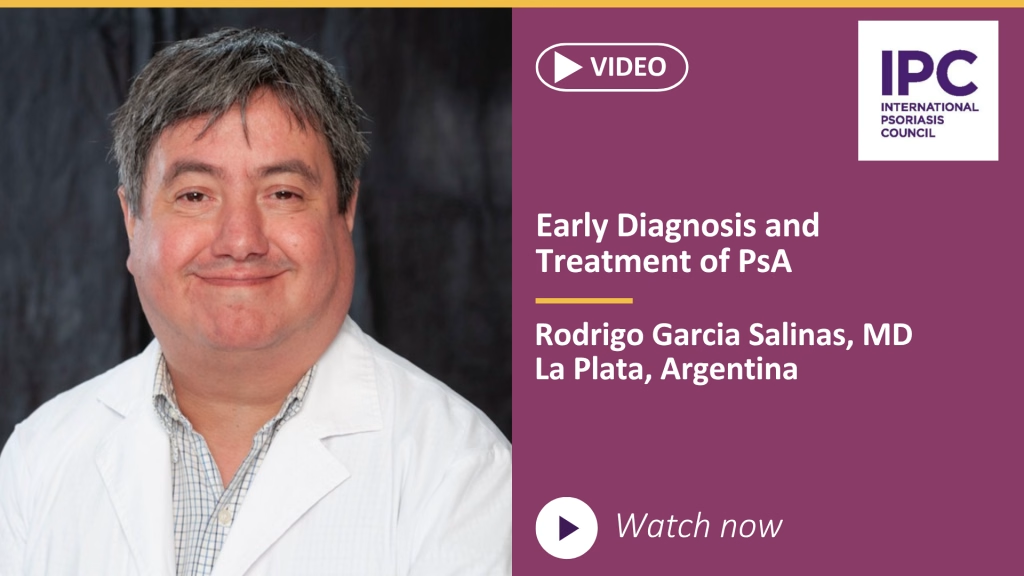
New Video Resource: Early Diagnosis and Treatment of Psoriatic Arthritis (PsA)

In this video, IPC Councilor Rodrigo Garcia Salinas, MD, a rheumatologist from Argentina, explains how to recognize psoriatic arthritis early, including why joint pain, how long a patient has had psoriasis, and family history can matter more than skin severity alone. He also reviews how imaging helps catch early disease and how to choose treatment based on each patient’s joint, spine, and skin involvement.

WATCH NOW

Friday, September 25, 2026

Take Ten Video: Bridging Psoriasis and Metabolic Comorbidities

IPC President Bruce Strober reviews the link between psoriasis and metabolic disease, drawing on findings from IPC’s recent paper in the Journal of the American Academy of Dermatology (JAAD). He translates this growing body of evidence into five concrete priorities from the 2025 IPC Think Tank for improving cardiometabolic screening and care.

WATCH NOW

Wednesday, September 9, 2026