
Video
Clinical Escape in Psoriasis: Paradoxical Reactions and Flip-Flop Phenomena.
Professor Wilson Liao discusses paradoxical reactions, including unexpected phenotypes and immune switching, and…
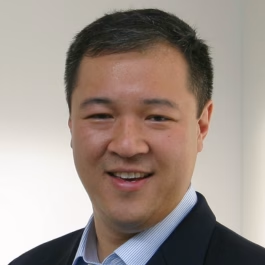
Professor Wilson Liao discusses paradoxical reactions, including unexpected phenotypes and immune switching, and…
Watch VideoIPC summarizes presentations from its symposium at the 2026 SID Annual Meeting, including disease interception,…
View ReportThe 2025 IPC Think Tank Congress Report highlights psoriasis as a systemic immunometabolic disease, linking obesity,…
View ReportThe International Psoriasis Council's global network of expert volunteers dedicates time each year to educating…
Read MoreThe 2024 Society for Investigative Dermatology (SID) Annual Meeting was held from May 14 to 18, 2024, in Dallas, Texas,…
Read MoreDr. Wilson Liao addresses four key questions concerning psoriasis and the microbiome: onset and severity, comorbidity,…
Watch VideoSOCIETY FOR INVESTIGATIVE DERMATOLOGY (SID) | DALLAS, TEXAS Wednesday, May 15 9:00 - 12:00 CDT Program chairs:…
The 2024 American Academy of Dermatology (AAD) Annual Meeting was held Thursday, March 7 – Tuesday, March 12, 2024,…
Read MorePlease join us in warmly welcoming Daniela Armijo, Ncoza Dlova, Benjamín Hidalgo Matlock, and Wilson Liao as IPC’s…
Read More| Cookie | Duration | Description |
|---|---|---|
| cookielawinfo-checkbox-analytics | 11 months | This cookie is set by GDPR Cookie Consent plugin. The cookie is used to store the user consent for the cookies in the category "Analytics". |
| cookielawinfo-checkbox-functional | 11 months | The cookie is set by GDPR cookie consent to record the user consent for the cookies in the category "Functional". |
| cookielawinfo-checkbox-necessary | 11 months | This cookie is set by GDPR Cookie Consent plugin. The cookies is used to store the user consent for the cookies in the category "Necessary". |
| cookielawinfo-checkbox-others | 11 months | This cookie is set by GDPR Cookie Consent plugin. The cookie is used to store the user consent for the cookies in the category "Other. |
| cookielawinfo-checkbox-performance | 11 months | This cookie is set by GDPR Cookie Consent plugin. The cookie is used to store the user consent for the cookies in the category "Performance". |
| viewed_cookie_policy | 11 months | The cookie is set by the GDPR Cookie Consent plugin and is used to store whether or not user has consented to the use of cookies. It does not store any personal data. |
IPC Jr. Councilor Towhida Noor reviews the psoriasis pipeline: selective TYK2 inhibitors, long-acting IL-17 and IL-23 biologics, and IL-36 blockade in GPP.
IPC Board Member and Treasurer Joel Gelfand, MD, MSCE, is the editor of a new textbook, Psoriasis: An Expert Global Perspective, now available for preorder from Elsevier. He worked with associate editors IPC President Bruce Strober, MD, PhD; IPC Vice President/President-Elect Claudia de la Cruz, MD; and IPC Chief Medical Officer Peter van de Kerkhof, MD, PhD. Nearly 50 authors from 20 countries contributed 30 chapters covering psoriasis from its earliest descriptions through genetics, immunology, and current therapies, with clinical images of psoriasis across diverse skin tones. All royalties support IPC.
PRE-ORDER YOUR COPY
In this video, IPC Councilor Rodrigo Garcia Salinas, MD, a rheumatologist from Argentina, explains how to recognize psoriatic arthritis early, including why joint pain, how long a patient has had psoriasis, and family history can matter more than skin severity alone. He also reviews how imaging helps catch early disease and how to choose treatment based on each patient’s joint, spine, and skin involvement.
IPC President Bruce Strober reviews the link between psoriasis and metabolic disease, drawing on findings from IPC’s recent paper in the Journal of the American Academy of Dermatology (JAAD). He translates this growing body of evidence into five concrete priorities from the 2025 IPC Think Tank for improving cardiometabolic screening and care.