International Psoriasis Council

Advancing Knowledge. Improving Care.

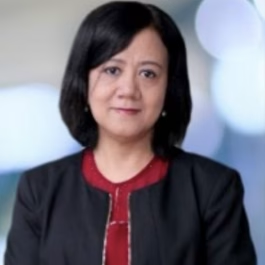
Khine Khine Zaw Headshot

Khine Khine

Zaw

,

MB, MS, PhD

Head of the Department of Dermatology
University of Medicine (1)
Yangon
,
Myanmar
Khine Khine Zaw is a Professor and Head of the Department of Dermatology at the University of Medicine (1) (UM1) Yangon. Prof. Zaw earned an MB and BS from the University of Medicine (1). After graduation, she worked as a demonstrator in the Department of Physiology at UM1, then went to Gunma University, Japan, as a state scholar student, earning a PhD in Dermatology. During her scholarship period, Prof. Zaw worked in the lab of Prof. Miyachi Yoshiki and Prof. Ishikawa Osamu and together characterized a novel three-dimensional fibroblast culture system that gave rise to a skin model in-vitro. She continued to research extracellular matrix metabolism and the role of antioxidants. Following graduation from Gunma University, Prof. Zaw pursued her career in dermatology as a dermatologist.
Last Updated:
11/04/2022

What's New

Use and Misuse of Systemic Corticosteroids in Psoriasis

In this Take Ten with IPC video, Professor Peter van de Kerkhof discusses the use and misuse of systemic corticosteroids in psoriasis. He questions whether they contraindicate the treatment of psoriasis, while also covering his personal experience in prescribing them.

WATCH NOW

Thursday, May 14, 2026

Use and Misuse of Topical Corticosteroids in Psoriasis

In this Take Ten with IPC video, Professor Peter van de Kerkhof discusses the use and misuse of topical corticosteroids in psoriasis, covering current use, guidelines, and consequences.

WATCH NOW

Thursday, May 14, 2026

Videos Now Available from the IEC & IPC Joint Symposium at AAD

Missed the joint symposium hosted by the International Eczema Council (IEC) and International Psoriasis Council (IPC) at the American Academy of Dermatology (AAD) Annual Meeting? Select presentations from Psoriasis or Dermatitis? When Boundaries Blur and Treatments Flip the Script are now available, covering diagnostic overlap, emerging tools, treatment-related reactions, and practical strategies for managing complex cases across diverse patient populations.

WATCH NOW

Wednesday, May 27, 2026